
Mbappé Penalized by Sponsors, China’s Economy Dips
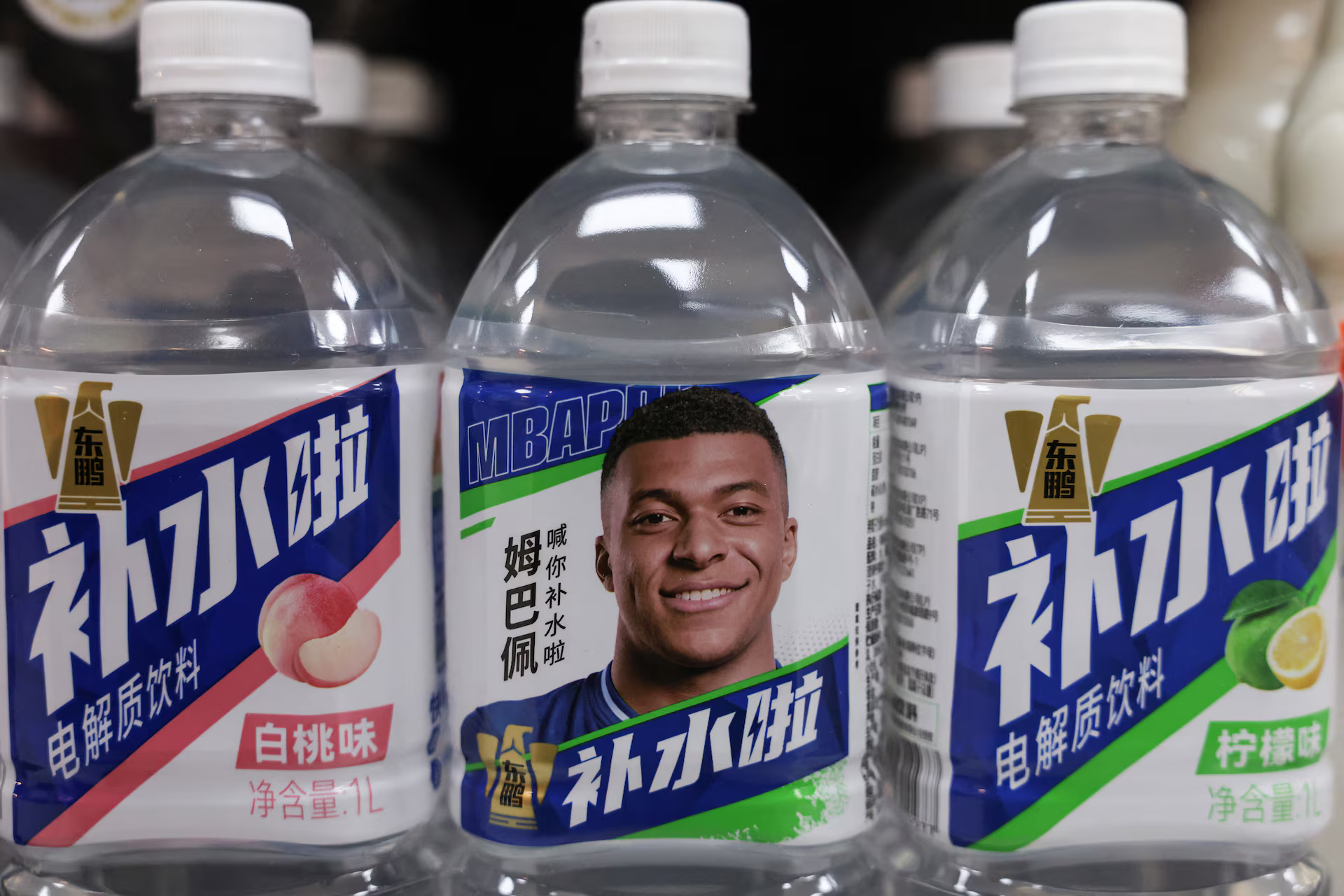
Drink advertisement featuring French soccer star Kylian Mbappé in Beijing, China. Source: Reuters.
The same day several Chinese brands announced they were ending sponsorship deals with French soccer player Kylian Mbappé, China’s stock market fell 1.3 percent. The two may be related, though not as directly as some internet users have joked about.
On Tuesday, multiple Chinese companies, including Chinese energy drink producer Dongpeng Beverage, issued a statement ending their deal with Mbappé, and his Xiaohongshu social media account was suspended. The companies did not specify in their statements why the partnerships ended; the announcements followed a clip featuring Mbappé referring to Mao Zedong, founder of the Chinese Communist Party, on X. Both Mbappé and La Liga formally apologized after the backlash.
The same day, Chinese stock markets dipped significantly. Some have jokingly posted on Instagram that the punishments France’s captain faced might be to blame, but that’s unlikely.
The market decline actually follows a downward trend from recent months. The STAR 50 Index, a tracker of China’s Shanghai exchange, has fallen 40 percent since June. Some analysts have cited a burst in China’s AI bubble. The AI industry has become a swiftly growing part of China’s overall market.
According to Goldman Sachs, AI is roughly 42 percent of mainland China’s market value. China’s reaction to the AI-driven dip reveals a concerning structural issue in its economy: government reliance and intervention.
The New York Times reported that the government-backed investment group termed “national team” invested $6.8 billion into the market, trying to slow the decline. Stocks continuing to drop suggests the Chinese government’s previously used move may not suffice. The move’s purpose could be to “set a floor” and stop downward momentum, as Gary Ng, an economist specializing in Asian banking, notes. However, because consumer confidence and spending have both declined, it does not matter in the long term where China sets a floor for the market; it won’t have enough momentum to grow again.
How then do Mbappé’s sponsorship worries relate to China’s economic dip? Ultimately, an economy that relies on the government stepping in to save it will inevitably be subject to the whims of its ruling party.
NBC News writer Mithil Aggarwal discussed some pressures companies can face to punish those who criticize China’s government. Their article quotes China’s Foreign Ministry spokesperson Guo Jiakun saying just as much. Jiakun said, “Words and actions that hurt the feelings of the Chinese people will naturally be met with a collective boycott by all sectors of Chinese society.” If hurtful words demand a nationwide boycott, long-term trust is hard; if the economy is at the mercy of the ruling political party, consumers must hope trading partners do not offend that party.
If China seeks long-term growth, loosening government entanglement could be necessary, but change for China may not be likely. Alexandra Stevenson and Murphy Zhao from The New York Times said, “Mr. Xi seems more focused on his political aims than on stimulating growth.”
Political ambitions might be a higher priority than the economy. If this is true, and the country could force government intervention to drop markets, China could have a much harder time digging its economy out of its latest slump.