
Trump, Tech Leaders, and Voters Can't Agree on How to Regulate AI
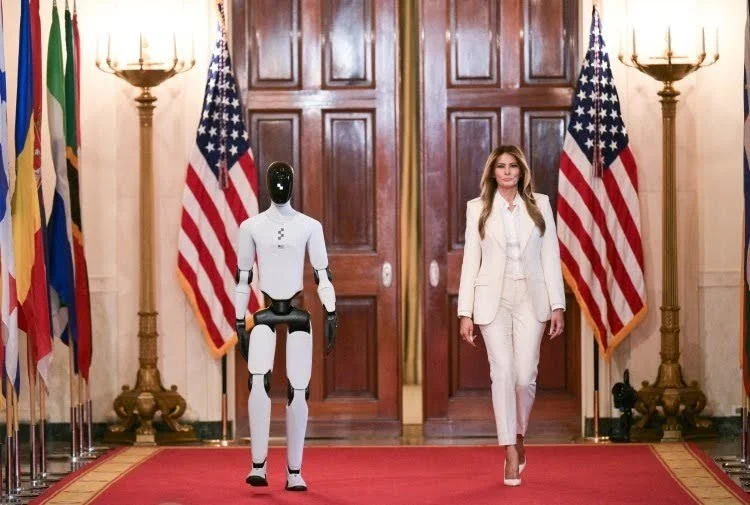
First Lady Melania Trump walks alongside a robot during a summit intended to promote AI technology in the classroom. Source: Getty Images.
Last month, Dario Amodei, CEO of the major AI company Anthropic, published an unexpected essay urging other AI leaders to join him in slowing the development of artificial intelligence. OpenAI co-founders Elon Musk and Sam Altman quickly released posts on social media agreeing with him, marking an unusual case of consensus between competing tech leaders. Until recently, these AI leaders were steadfast in their support for the rapid expansion of AI. The environmental impact of AI is not a novel concern, and until recently, tech companies have effectively avoided the conversation or have asserted that the technology could actually advance the fight against climate change.
In theory, Amodei, Musk, and Altman should have a vested interest in protecting their consumers. Instead, the move appears to primarily serve as self-preservation. In the past few months, a string of incidents where AI systems have independently hacked other AI models has alarmed the industry. Furthermore, investors fear that the AI industry in China will soon surpass the capabilities held by American tech companies. While companies may outwardly emphasize their passion for safeguarding social and environmental rights, they hold a deeper desire to maintain confidence among investors and prevent unregulated competition from racing ahead.
Shortly after this series of statements, President Trump announced on Truth Social that he will create a task force to manage the growth of AI, led by an "AI czar." At first glance, Trump's announcement seems like an upfront reaction to the concerns raised by tech leaders. Amodei directly called on the U.S. and other democratic nations to "establish common safety standards as well as limits on the rate of unchecked AI progress." Instead, Trump appears more determined than ever to accelerate the development of artificial intelligence without government interference. In his post, the president frames the debate surrounding AI as a conspiracy by left-wing politicians, and claims that he "will not in any way hinder or stifle the growth of this incredible industry." To the president, the rapid development of AI technology is only one piece of his broader trade war with China. Trump believes that "whoever wins AI, wins," positioning it as a tool to reinforce America's global influence.
While the president has framed the discussion surrounding AI as an inherently partisan matter, republican, democrat, and independent voters are united in their concern about the rapid expansion of AI. According to a poll conducted by CNN in September 2026, over three-quarters of Americans are concerned about the accelerated development of AI and data centers. Over half of MAGA-identifying republicans expressed concern. Amidst record-high energy prices, the debate surrounding the energy consumption of data centers is more relevant to voters than any discussion about AI's economic benefit or the threat of Chinese supremacy.
The disconnect between the president's fixation with artificial intelligence and the tangible concerns many Americans have with the cost of living has started to alarm some republican politicians. Last month, Republican Senators John Curtis and Josh Hawley announced that they would be joining forces with Senate Democrats to advance legislation regarding AI regulation. Hawley noted, "We might want to be on the side of voters—just a thought." Democrats have certainly been more proactive in their calls to regulate artificial intelligence, but party leaders have struggled to identify a unified strategy for regulation.
In a poll conducted by The New York Times in September 2026, 42 percent of respondents indicated that they trusted the Republican Party more with handling AI regulation, while 40 percent of respondents trusted the Democratic Party. Importantly, voters highlighted that the rising cost of living would drive their vote choice during the midterm election, not AI policy. Instead, distracted by the influx of donations from AI-aligned "super PACs," Congress spent much of the last month debating AI regulation. And even so, Congress is poised to leave Washington without a single piece of AI legislation prior to the midterms.
Even though AI regulation is not the most pressing issue on voters' minds, the growing influence of the domestic and foreign AI sector is inescapable. The growth in artificial intelligence has evoked an array of reactions from Americans—environmental groups are distressed by the electricity and water consumption of data centers, labor rights activists are worried about job displacement, and artists feel blindsided by AI-generated content. Amidst the various concerns of American voters, tech companies are funneling their profits and influence into appeasing the government. Even after the midterm elections, the debate regarding AI and governance shows no signs of slowing.
Altogether, neither the concerns of AI tech leaders nor the concerns of President Trump are representative of the general public sentiment about AI technology. AI companies are concerned about how unregulated competition will impact their profits, and Trump fears Chinese supremacy. Across the board, American voters understand that this debate will do nothing to lower the cost of living. As the AI tech boom accelerates, politicians have failed to acknowledge the real issues voters face as November elections approach. With regard to AI policy, neither party holds a clear advantage.