
Egypt Approves Potential Military Support to Saudi Arabia
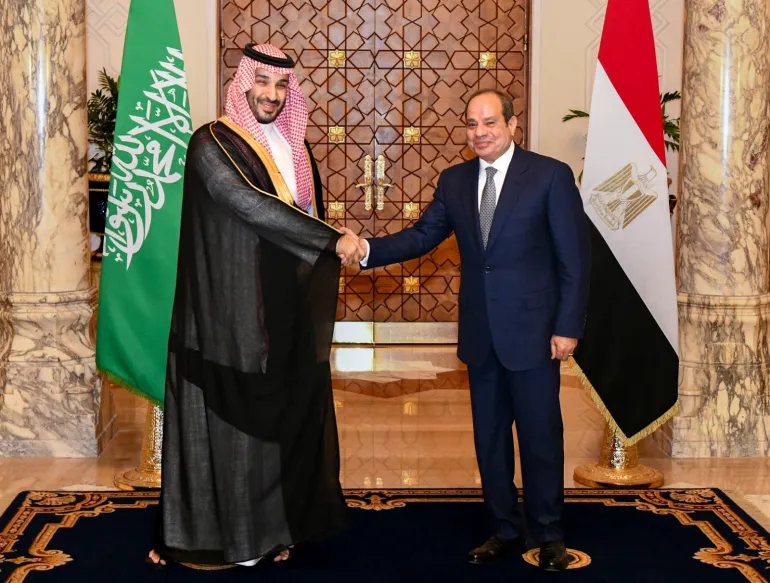
Egypt’s President Abdel Fattah El-Sisi shakes hands with Saudi Crown Prince Mohammed bin Salman in Cairo. Source: Al Jazeera.
On Sunday, October 25, Egyptian President El-Sisi called for an emergency session of Parliament to authorize a request never decided before: approving potential Saudi Arabian requests for defense military assistance. Following weeks of fighting between the Iran-backed Houthi insurgents and Saudi-aligned government forces in Yemen, the conflict has spilled onto Saudi territory. To analysts, Riyadh’s push to lobby regional allies for defense aid reflects growing anxiety after Houthis intensified their maritime blockade and targeted crucial infrastructure. However, others may be surprised by Cairo’s proactivity in pledging further military involvement in the Red Sea crisis rather than closer allies like Pakistan, Turkey, or the United States. The prospect of Egyptian involvement in the twelve-year-long Yemeni civil war and maritime crisis may leave both Egyptians, Yemenis, and other actors questioning what the regional theater of conflict may look like now.
Historically, Egypt has been no stranger to leading and supporting previous Yemeni civil war efforts against its new ally, Saudi Arabia. Fifty-three years ago, during the successful North Yemen Civil War, Egypt was one of the few republican supporters of the Saudi-backed royalists and heavily influenced the Mutawakkilite kingdom’s 1962 coup d'état. Cairo asserted its pan-Arab strategic interests by cultivating a military relationship with the revolutionary leader Abdullah Yahya al-Sallal to counter diplomatic isolation from other pro-West Arab monarchies, like Saudi Arabia.
Despite Egyptian ex-President Gamal Abdel Nasser’s keen interest in Yemen’s regime change to assert dominance over the Red Sea, historians and political analysts alike now view Nasser’s commitment to the conflict as detrimental to its performance in the 1967 Six-Day War against Israel. Nasser withdrew his forces before the successful Seventy-Day Siege of Sanaa, where Saudi Arabia acquiesced and eventually recognized the Yemen Arab Republic. Now widely referred to as “Egypt’s Vietnam,” it faced criticism, and many considered it crucial to forming Cairo’s independent and strategic neutrality. Cairo may have heeded warnings to avoid the same fatal proxy power struggle against Saudi Arabia in Yemen this time; critics may interpret this as a sign that Cairo should not get involved in Yemen again.
Over 50 years later, a different civil war echoes the same power struggle in the rest of the Middle East. The 12-year-long civil war in Yemen launched after the ex-president refused to step down and commanded the military to kill pro-democracy protestors in the capital Sanaa. After an internationally brokered deal, the once-marginalized Houthi rebels in the North—as well as secessionists in the south—rejected constitutional reforms and captured the capital. Though similar to the older Civil War, Egypt remained silent, and Saudi Arabia’s intervention has grown substantially, influenced by fears of growing rival Iranian influence south of its border. Even more importantly, analysts may find the failed international interventions to blame for the civil war’s escalation compared to the previous revolutionary civil war.
Almost 12 years later, the civil war relit the region’s tensions, testing Saudi hegemonic control. Yemen’s internationally recognized but unpopular Saudi-backed government launched an attack on a Houthi-controlled airport, breaking a four-year-long ceasefire and escalating the conflict into a broader Red Sea crisis. The Iran-aligned Houthi group then seized the strategic port city of Mokha and launched targeted strikes at Riyadh. Formally known as Ansar Allah (Partisans of God) and part of the Iranian Axis of Resistance, they have also launched missiles at their allies: Israel and the UAE. Experts may comment that Iran and Saudi influence has complicated the war into a proxy war affecting maritime shipping and supply chains in the Red Sea. This has spilled over into a global crisis where it may seem that every regional actor, other than Egypt, is acting to its defensive advantage. Parallels to the earlier civil war, except for the involvement of other actors in the region’s bloated theater of conflict and Egypt’s absence.
This shift in regional hegemony around the Red Sea and the Bab al-Mandeb Strait has forged new blocs in unpredictable ways that Cairo could be considering. Saudi Arabia appears to have formed its own axis in the region, maneuvering the status quo towards strategic self-reliance in the maritime trade corridor by establishing the Mecca Defense Alliance this summer. NATO member Turkey and nuclear-armed Pakistan also partake in the collective defense pact where an armed attack against one nation is considered an attack against all.
Critics may point out that this vague pact with no clear national commitments lacks credibility if members won’t coordinate as effectively as NATO does, but the members’ delegations proved effective in organizing discussions with the Iranian President Masoud Pezeshkian and officials to de-escalate the war. This regional defense agreement has shifted the accepted norms of anarchy and self-interest toward unity that may attract or deter other key actors, like Egypt.
The ‘NATO of the East’ crucially leaves out Egypt, also a member of the Regional Four alliance like the tripartite group. Many hypothesize the republic’s absence from the pact could be a result of fears of non-alignment and entrapment. However, as Houthi forces continue to control global chokepoints connected to Egypt’s Suez Canal, Cairo may be forced to reckon with the prospect of joining the Mecca Joint Defense Agreement to protect their shipping routes. Egyptians have lost an estimated $10 billion in Suez Canal tolls due to the Houthi attacks, which may prove consequential to their ailing economy. Their steady military offer to Saudi Arabia could be seen as an informal bid to join the defense alliance.
Though analysts may draw historical comparisons to when Egypt invoked the Arab League’s preexisting collective security treaty to deploy forces during the 1990 Kuwait Liberation War, their reluctance to involve themselves in another protracted war in Yemen remains strong, though malleable to promises of Saudi-led stability in the region.
Egypt’s shift in international neutrality has surprised some officials but comes to no surprise to other analysts of the region. Gulf intellectuals have criticized the middle power’s hesitance to support the region after Iranian attacks, despite Saudi Arabia and the United Arab Emirates’ financial largesse to overcome its economic troubles. Analysts defend Egypt’s preferred mediation role as Cairo seems unable to afford further military entanglement. Egyptians face staggering fuel-price hikes and systematic power outages, on top of a sizable external debt that accounts for forty per cent of its GDP. It could be hard to imagine Sisi’s financial flexibility in dispensing hard power in this crisis, as the Organization of Petroleum Exporting Countries, without the UAE, no longer seems willing to give unrestricted financial support.
Gulf criticism seems to have struck a chord with the Egyptian “canary in the coal mine” as Sisi deployed a squadron of Rafale fighters to the UAE in response to the Iran War. Analysts may warn that the country could be forced to take more strategic and actionable imperatives to avoid alienating its Gulf allies further. This may extend beyond authorizing defensive support to Saudi Arabia upon request and into playing a bolder role in the region on security in the future.
Writers may warn that it’s unwise to assume Egypt is incapable of taking an impassive approach to the region’s conflict. Cairo plays a critical military role in the Horn of Africa, greatly influencing geopolitical tensions in the Middle East and the Red Sea. Sisi expanded naval presence in the Red Sea and signed military-grade agreements to deploy warships to Eritrea and Djibouti. Analysts observe Cairo using realpolitik to pressure landlocked Ethiopia to stop its maritime push on the Red Sea rather than supporting Eritrea’s sovereignty.
Cairo makes strategic access to the Red Sea’s Gulf of Aden and Suez Canal a key priority by deploying troops to Somalia’s Mogadishu this year. Experts might be keen to point out Cairo and Mogadishu’s stance against Israel’s recognition of Somaliland and Sisi’s likely worries over their neighbors' new footprint in the Horn of Africa uprooting his strategic control over the familiar theater and maritime route. Diplomats may insist that Cairo is not afraid to assert itself with its neighbors, as Egyptian military forces deployed into the Sinai Peninsula showed after the 2023 bloodshed in Gaza.
While Cairo may operate silently with its Gulf financial backers, it can work as a fragile keystone of security in the region if they replicate their approach in the Horn of Africa. If their actions in the Horn are the model for Egypt’s future operations in Yemen, Houthis may expect significant limitations to their attacks, and the impact on Red Sea shipping routes could be restricted. The extent to which Sisi could act in Yemen is yet to be decided, as he maintains stability and Red Sea port access in other southern countries.
Whether this could result in actual military operations for Cairo’s Gulf ally is yet to be answered; however, this marks a big shift in trajectory for the middle power. The Egyptian Parliament approved the symbolic boost to its Gulf allies, authorizing the country’s military to provide aid to Saudi Arabia, though it would not engage in direct offensive military operations. As wars in the Middle East rage on and Houthis become emboldened, Sisi may have run out of diplomatic options, and waiting any longer to militarily partner with Saudi Arabia may prove more detrimental.
Cairo may be haunted by the ghosts of their ill-fated 1960s Yemen intervention, but Gulf security officials may rush Sisi to put them to bed if maritime shipping security in the Red Sea continues to falter. Flexing the republic’s military might could quell further instability as it has in the Horn of Africa, both regionally and economically. That could only be if Riyadh has to call Cairo to act on its pledge, though likely after the Mecca Alliance’s bluff is called first. Sisi could continue threading the needle in the Middle East as the silent republic earns its seat at the table again.