
Morocco’s Gen Z Is Frustrated… and the Polls Prove It
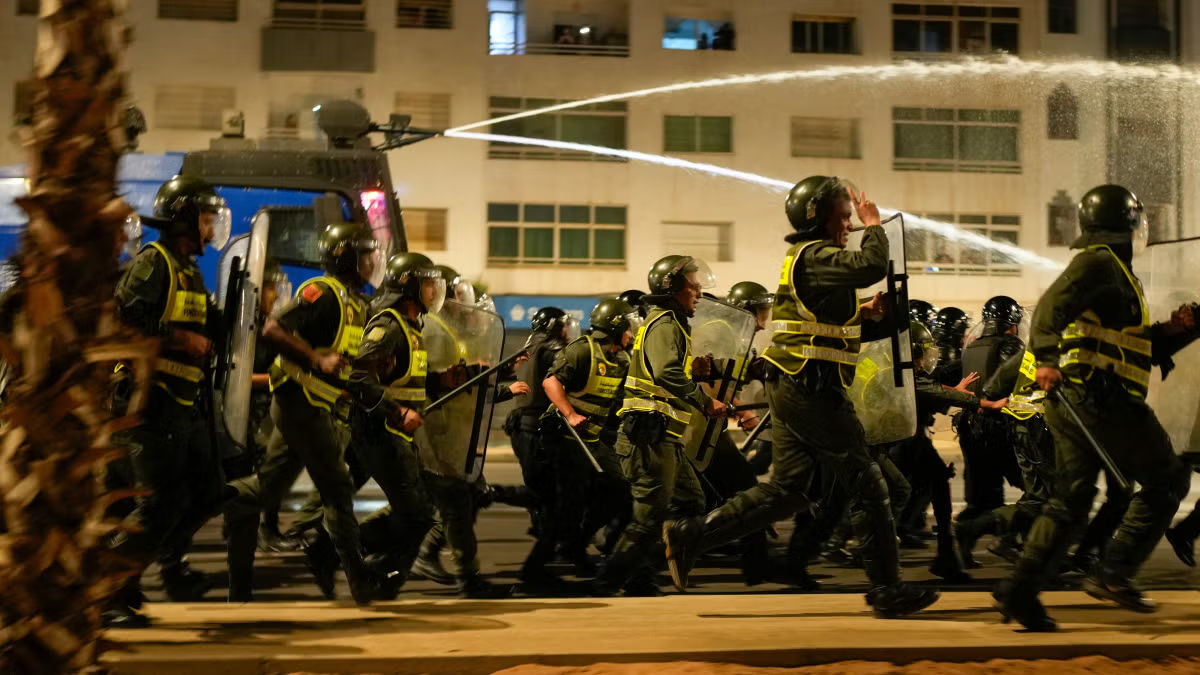
Security forces use water cannons to disperse youth protesters calling for healthcare and education reforms, in Salé, Morocco, October 1, 2025. Source: Human Rights Watch.
Environmental entrepreneur and founder of the Environment and Sustainability Party Hamza El Kharroubi participated in last year’s protests alongside many other Gen Z activists, predicting to Al Jazeera that the protests would boost youth engagement in politics and electoral turnout in the near future.
However, Morocco’s parliamentary election on September 23, 2026, revealed a different reality: only 19 percent of those under thirty-five registered to vote. Despite making up 12 percent of the population, youth aged eighteen to twenty-four accounted for only about 4 percent of registered voters. The overall turnout among the general public was similarly dismal, with only 38 percent of the 15.8 million people who registered to vote actually casting a ballot.
Many young people in Morocco choose to stay disengaged from formal politics. It is necessary to distinguish between conscious disengagement and indifference or ignorance. This disillusionment stems from last October’s protests in Agadir, a city in southwest Morocco, over public healthcare, education, jobs, and living conditions. The outrage followed the death of eight women during Cesarean births in a dilapidated municipal hospital.
It was not until September 27 that the demonstrations expanded significantly. A leaderless movement calling itself GenZ 212 mobilized nationwide, primarily through Discord, TikTok, and Instagram, to protest decaying public infrastructure, systemic corruption, and high youth unemployment. Inspired by similar youth movements in Nepal and Madagascar, GenZ 212 demanded that Prime Minister Aziz Akhannouch step down.
A major source of frustration for the young demonstrators is the enormous amount of government funds being allocated to the 2030 FIFA World Cup, which Morocco will host alongside Spain and Portugal. The International Monetary Fund calculated expenditures related to the tournament were nearly 12 percent of Morocco’s 2024 gross domestic product. As chants of “Healthcare first! We don’t want the World Cup” echoed through the streets, protesters highlighted two issues: the shortcomings of public healthcare funding serving Moroccan people, versus government spending on an international tournament that bolsters the global reputation of Morocco's ruling elite.
A second source of unrest involved migration. In just a few days in July, over 70,000 migrants made their way to Ceuta, a Spanish exclave on Morocco’s northern coast, resulting in over 141 deaths, the majority of them young Moroccans. Thousands of migrants travel to Morocco’s coasts each year to reach exclaves like Ceuta or Melilla, moving toward mainland Europe for better economic opportunities.
A secondary catalyst for youth unrest centers on migration and border enforcement. A rise in social media posts calling on migrants to make their way to Ceuta led many to attempt to reach the exclave by land or sea. Moroccan authorities arrested 61 Moroccans accused of facilitating the migration attempts. Moroccan media also reported the arrest of 294 migrants from sub-Saharan Africa after an attempt to enter the exclave. At least ninety people were killed. Each day, more than 20,000 Moroccan security personnel are deployed along the Moroccan border with Ceuta, at a cost of hundreds of millions of dollars. Youth frustration therefore reflects national authorities’ handling of migrants, particularly in light of recent migrant deaths and arrests, and deep discontent over economic opportunities and insufficient infrastructure in Morocco that may be driving migration.
To understand the broader future implications of Moroccan youth expressing their frustration, it helps to consider Indian and Nepalese Gen Z protests. When the Chief Justice of India called unemployed Indian youth “cockroaches,” a 31-year-old decided to found a protest movement called the Cockroach Janta Party (CJP). For several months, youth protests in India have emphasized anti-corruption, free speech, and strong public services. After the CJP led protests for accountability after allegations that entrance exams to esteemed medical schools had been leaked and sold, the national minister of education resigned. The protests that began in Nepal last September were of a similar nature. Gen Z-led social media movement protesting wealth inequality, unemployment, and a lack of economic opportunity led to the resignation of several government ministers, including the home minister.
However, Gen Z protests do not always create the desired outcome. On Friday, October 16, India’s CJP leader was detained by police as part of a crackdown on anti-government protests in the capital. Nepalese youth faced a government ban on more than two dozen social media platforms. In response to the violent protests, police used live ammunition, water cannons, and tear gas.
When younger generations express their frustration, the message is loud. Listening or ignoring is a choice the political elite make. Youth movements could bring about change, including the resignation of several political elites. However, they have also led to intimidation or suppression of their freedom of expression. Morocco’s youth have followed similar paths to those of their Nepalese and Indian counterparts. They identified concerns, organized through social media, then mobilized in person, in the streets and at the polls, asking that their prime minister step down.
In response, the government has taken various measures nationwide. Riot police and plainclothes officers made arrests on September 27 and 28. Police in Agadir fired on demonstrators they claimed were storming one of their posts. A police van crashed into demonstrators in Oujda, a city in the east. Elsewhere, however, security forces eased their presence. The prime minister and his cabinet members said they were open to dialogue with protesters and suggested opening new medical facilities and fortifying existing ones.
However, Morocco’s youth remain frustrated. Many may feel the government’s promises are hollow, or merely a way to placate young people and preserve the administration’s power. Some issues remain unaddressed. For instance, no political leader has discussed reallocating stadium funds to social services. The government also seems to have avoided addressing the issues in Ceuta as much as possible. As long as the government fails to address these issues at their root, Moroccan youth will likely continue to show up for their future, in the streets and at the polls.