
New Medicaid Cuts Strip Legal Immigrants, Refugees, and Trafficking Victims of Health Coverage
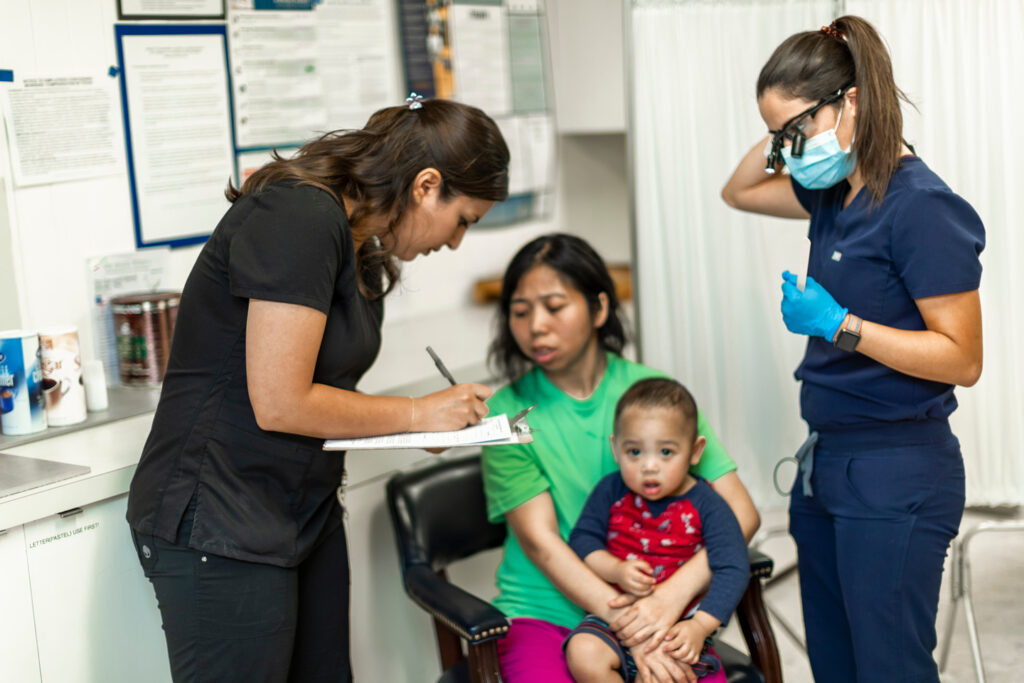
UT Health San Antonio Refugee Health Clinic. Source: Student Run Clinics.
On October 1, 2026, new federal eligibility restrictions took effect, abruptly terminating Medicaid and the Children’s Health Insurance Program (CHIP) coverage for hundreds of thousands of lawfully present immigrants across the United States. The policy shift removed long-standing statutory protections for some of the country’s most vulnerable legal residents, including political refugees, asylum seekers, and registered survivors of human trafficking and domestic violence. This policy shift is part of many sweeping provisions in recent federal budget reconciliation legislation.
The immediate fallout has exposed the real human cost of the budget provisions. According to policy estimates from KFF, over 281,000 legal immigrants across nine states and the District of Columbia lost their health coverage overnight, with state-level terminations reaching 177,000 in Florida and 29,000 in Arizona alone. Families relying on specialized, life-sustaining medical treatments, such as pediatric cancer care or chronic prescription therapies, found themselves with mere days to secure alternative care or face total disruption and healthcare abandonment.
The policy changes trace back to the landmark budget reconciliation legislation signed into law by President Donald Trump. Overhauling decades of safety net policy, H.R. 1, commonly known as the One Big Beautiful Bill Act, targeted public assistance programs to offset broader tax cuts and rein in mandatory federal outlays. Among its contentious health provisions was a strict overhaul of noncitizen benefit criteria designed to narrow federal matching support. Congress established October 1, 2026, the first day of the 2027 fiscal year, as the hard deadline for state Medicaid agencies to redetermine eligibility and end federal financial participation for all lawfully present non-citizens outside a narrow set of groups, such as Lawful Permanent Residents (LPRs) who have met standard waiting periods, Cuban/Haitian entrants, and Compact of Free Association (COFA) migrants (citizens of the Federated States of Micronesia, the Republic of the Marshall Islands, and the Republic of Palau which make up the Freely Associated States).
The primary motivation behind these health coverage cuts is the intersection of federal deficit reduction and the core tenets of President Trump’s domestic and national security platform. Proponents in Congress and the White House frame the eligibility restrictions primarily as an essential measure to control federal spending. Estimates from KFF health expenditure projections demonstrate that restricting federal matching funds for non-citizens contributes to a broader set of Medicaid adjustments projected to reduce federal outlays by up to $911 billion over a ten-year window.
Beyond budgetary goals, the administration defends the rollbacks as strict enforcement of its “America First” agenda, asserting that legal immigration to the U.S. should be contingent on economic self-sufficiency. In their policies, officials maintain that taxpayer-funded safety-net programs should prioritize native-born citizens and permanent residents. Under these tightened rules, lawful humanitarian groups are now subject to standard five-year waiting periods or barred from federally matched coverage altogether, effectively shifting financial obligations directly onto individual and local providers.
In response to widespread criticism, White House supporters have suggested that charitable organizations, non-profit clinics, and private philanthropic initiatives can step in to assist affected immigrants. However, healthcare leaders and community advocates emphasize that private entities cannot come close to bridging the massive coverage gap left by federal withdrawal.
As WLRN reported, local community health centers and free clinics operate on thin margins and lack the financial resources and specialized clinical infrastructure to replace comprehensive health insurance. While private charities can occasionally provide basic primary care consultations or stopgap prescriptions, they cannot absorb the immense costs of specialized surgeries, cancer treatments, or long-term care. Furthermore, because federal rules have also restricted Emergency Medicaid reimbursements, public and safety-net hospitals can no longer easily recoup the costs of emergency room care for these uninsured patients.
The Medicaid rollbacks come at a time of heightened economic stress for low-income households across the nation. The concurrent rollout of federal reductions to food assistance programs like SNAP has compounded hardships for legal immigrant families, leaving local food pantries and community health networks overwhelmed by unprecedented demand.
While a coalition of state attorneys general has filed legal challenges to halt enforcement of these provisions, implementation is underway across most of the nation. Public health analysts conclude that rather than promoting self-sufficiency, stripping health coverage from legal immigrants will result in delayed medical care, worsened population health outcomes, spiraling uncompensated care costs for local emergency rooms, and severe financial distress for working families across the country.