
Pakistan Seizes Control of Province
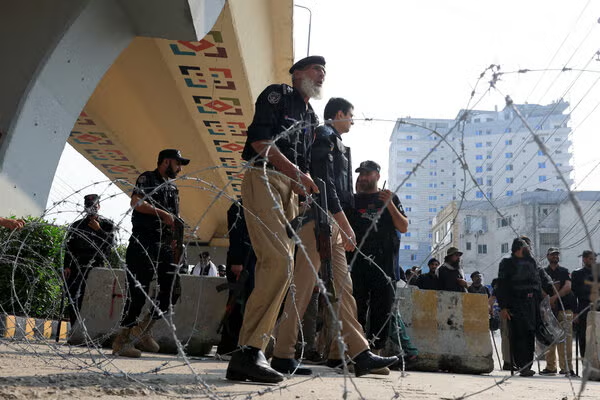
Police officers guarding a road in Peshawar, Khyber Pakhtunkhwa on October 11. Source: The New York Times.
On October 11, Pakistani President Asif Ali Zardari imposed a state of emergency and governor’s rule in Khyber Pakhtunkhwa, a northwestern province with a population of 40 million, which makes up 17 percent of Pakistan’s total population. The executive order suspended the provincial government led by the Pakistan Tehreek-e-Insaf (PTI) political party, founded by former Prime Minister Imran Khan. Khan, who was ousted from office in 2022 through a no-confidence vote and has since been convicted in numerous corruption and graft cases, has been in prison since August 5, 2023.
The state of emergency declaration was invoked under Articles 232 and 234 of the Pakistani Constitution. Article 232 permits that the President may issue a Proclamation of Emergency if national security “is threatened by war or external aggression, or by internal disturbance beyond the power of a Provincial Government to control.” Article 234 allows the federal government to assume control over a province if the President believes said Provincial Government cannot function in accordance with constitutional mandates.
Federal officials supported its assumption of control of Khyber Pakhtunkhwa by citing a surge in recent militant terror attacks in the region, accusing the PTI leadership of deliberately disengaging from counterterrorist efforts, therefore failing to maintain public order and safety and allowing for the operation of militant groups. Specifically, the Tehreek-i-Taliban Pakistan (TTP)—a coalition of militant and extremist groups with roots in the Afghan Taliban—has escalated its campaign of attacks against Pakistani security forces and state-affiliated entities across Khyber Pakhtunkhwa, which borders Afghanistan.
The PTI-led provincial administration has rejected the increased military operations against the TTP, passing resolutions opposing or questioning federal military operations and their potential success in preventing terror attacks; it has also threatened to block such counterterrorism operations.
This declaration comes just one week after Chief Minister Sohail Afridi launched an October 4 protest march to Islamabad demanding the release of Imran Khan. The PTI leadership has since rejected the imposition as an attempt to suppress their political power and prevent the march to Islamabad. Zulfikar Bukhari, former special assistant to Khan, said that the federal government’s action was "more of a coup disguised as emergency," warning that more bloodshed and instability would arise from the imposition.
Criticism of the federal government’s actions comes from sources outside the PTI; Maulana Fazlur Rehman, leader of the JUI-F political party, condemned the move, stating that an "Imposition of emergency is an ambush on democracy."
International rights organizations have expressed severe concerns over the maintenance of human rights obligations under military rule. Babu Ram Pant, Amnesty International’s Deputy Director for South Asia, warns that “the deployment of the army further militarizes the province and could create conditions for unlawful use of force.” Human rights groups report arbitrary arrests of provincial leaders, including Chief Minister Afridi.
Following the order, some areas of Khyber Pakhtunkhwa have experienced a suspension of telecom, mobile, and internet services. The national media is also facing heavy censorship, and Pakistan’s media regulator has warned television channels against doing live coverage of protests and terrorist attacks.
The suspension of such services in Khyber Pakhtunkhwa aligns with a broader national trend toward a highly regulated media and digital space. Reports show that the federal government has increasingly deployed digital firewall infrastructure, blocked virtual private networks, and conducted mass and covert surveillance without transparent judicial oversight. Further legislation reflects an expansion of state authority over digital media under public interest justification. In 2025, the Prevention of Electronic Crimes (Amendment) Act was passed by Parliament. The act established the Social Media Protection and Regulatory Authority (SMPRA), which operates as an autonomous regulatory body that oversees online content and enforces standards.
Additionally, the act introduced penalties, including imprisonment, for the spreading of "false and fake information" that causes fear, panic, or social unrest. International organizations such as Amnesty International have raised concern over the ambiguous framing of the offenses and the potential to suppress political opposition, watchdog journalism, and free speech.
The imposition of the federal government reflects a wider struggle within Pakistan between the protection of freedom and rights and the maintenance of protections against terror attacks.