
Albania on the Brink: How Internal Strife May Jeopardize International Status
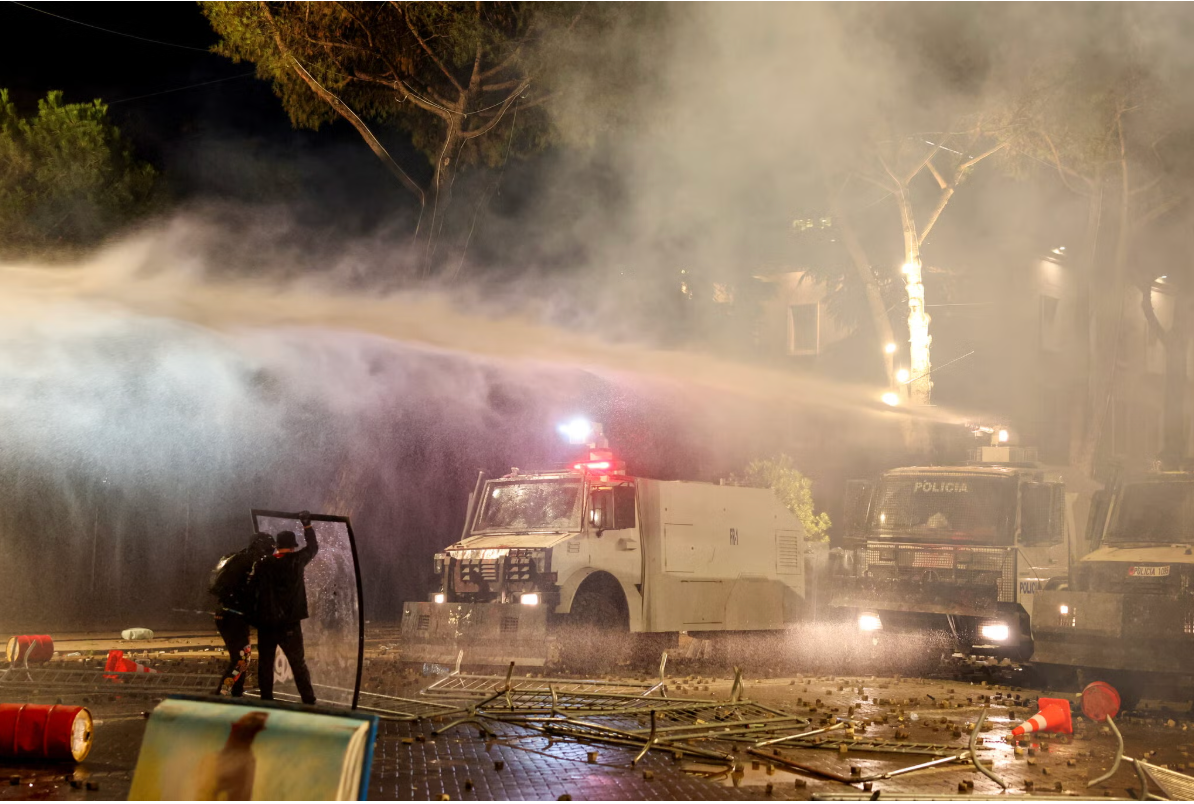
Protesters being sprayed by a water cannon in Tirana on October 16, 2026. Source: Getty Images.
Albania has joined the list of European countries facing unrest, as months of peaceful protests have given way to violent clashes between students and police. Many have been injured on both sides. With Albania considered one of the leading candidates for European Union membership, the rest of Europe is watching closely.
Protests first surfaced after initial work began on a multi-billion-dollar luxury real estate development linked to U.S. President Donald Trump’s son-in-law, Jared Kushner, and Middle Eastern investors. The deal includes two plots of land: the island of Sazan and a protected, ecologically delicate coastal landscape in Zvërnec. Kushner’s company, Affinity, spearheaded the initiative, alongside his wife Ivanka Trump, who served as the public face of the development. Following Donald Trump’s reelection in 2024, the Albanian Strategic Investment Committee, chaired by Prime Minister Edi Rama, granted Affinity special “strategic investor” status, conferring state assistance, fiscal benefits, and priority.
Peaceful demonstrations began on May 16, 2026, when local residents and environmental activists gathered in Zvërnec following the arrival of heavy machinery and barbed wire for preparatory work along the coastline. Protesters designated the pink flamingo—native to the area and part of the local ecosystem—as the symbol of their resistance. What began as a localized ecological movement quickly transitioned into what would become known as the “Flamingo Revolution” after a May 31 video went viral, showing a private security guard at the Zvërnec site dragging a protester along the ground. The unrest quickly spread one hundred miles north to the capital of Tirana and across major provincial urban centers.
This was just the beginning. Environmental grievances quickly metastasized into a massive, civic, anti-corruption movement demanding the resignation of Albanian Prime Minister Edi Rama. Protesters carried pink inflatable and paper cutout flamingos as a symbol of their resistance. The rallying call became “Albania is not for sale.”
Throughout the summer, protests remained largely peaceful, featuring predominantly young people, but soon much of the population began protesting with them. There were designated children’s areas at the protests, and a family-oriented environment was created as well. As fall approached, participation gradually waned.
On October 13, 2026, new violent demonstrations erupted across Albania as part of a collective movement by students, including those in secondary schools, demanding action from the government to help with education fees, books, and the rising cost of living.
Organized by the Albanian Student Union outside Tirana’s Education Ministry, demonstrations rapidly deteriorated into urban rioting, as masked protesters began vandalizing public and private infrastructure, breaking windows and even burning vehicles. Some also hurled Molotov cocktails and stones at police officers, ultimately leading to the ignition of a fire inside the Education Ministry building.
Unlike the previous peaceful protests of the Flamingo Revolution, a majority of these protesters adopted face coverings, which became a point of speculation and criticism. Prime Minister Rama claimed that the student movement had been "taken hostage” by a few hundred people hiding their identities with the sole goal of creating chaos.
Security forces responded by deploying water cannons and tear gas, batons, and rubber bullets. Many members of the police force were injured, and videos showing violent clashes between demonstrators and officers have circulated online. Authorities have since detained 160 people, with more than 380 charged.
Student demands quickly expanded beyond education, calling for an end to the corruption plaguing the government, and specifically, the removal of Prime Minister Rama from office. Although the earlier Flamingo Revolution had demanded similar action, there had been no confirmation from leaders of both movements that the two groups were connected.
This is a highly important moment in Albania as the country is one of the prime candidates for European Union membership. With Europe watching closely, the unrest has sparked political accusations over who was responsible for provoking the violence. Prime Minister Rama has partly blamed Democratic Party Opposition Leader Sali Berisha for the unrest, while Berisha has denied the Opposition's involvement, despite a demonstrated desire to oust Rama. Student protestors explicitly distanced themselves from established political parties.
Rama further alleged that Albania's move to join the EU has motivated certain groups to destabilize the country, stating that “These are foreign hands that do not wish for Albania to be at peace,” and that they don’t want “Albania to be part of the united European family.” Rama has also claimed that Iran, a long-time adversary of Albania, has also been involved in the unrest because of his refusal to expel Iranian dissidents from the country. Further, Rama reported that an outside force sent a drone with explosives to strike his office, but it was destroyed by security forces before it could make contact.
While the motivations of each group of protesters may differ, the demonstrations resulted in exposing broader frustrations over corruption, economic inequality, and Albania’s future. It remains to be seen if the chaos and instability are going to cost the country its coveted admission into the European Union.