
How the Midterms Will Shape the 2028 Presidential Ballot
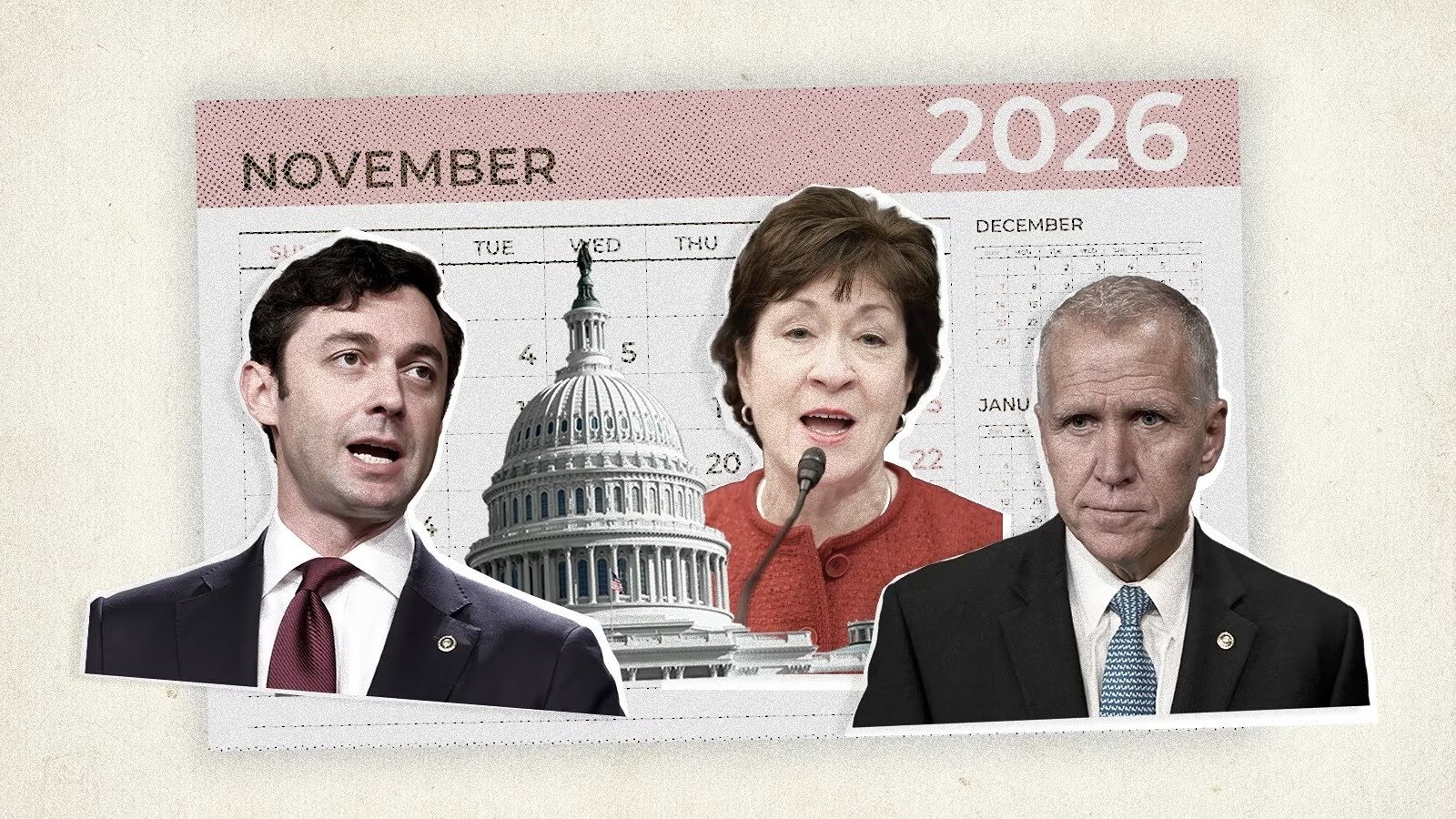
Senators Jon Ossoff (D-GA), Susan Collins (R-ME), and Thom Tillis (R-NC) are among the candidates fighting for a seat in battleground states. Source: ABC News.
Following two years of a Republican trifecta—with GOP control of the House, Senate, and Presidency—the 2026 midterm elections could meaningfully shake up federal priorities. Looking beyond the immediate impact on Congress’s partisan makeup, these races will help answer a bigger question: which kinds of politicians and politics are best prepared to win the White House in 2028? Politicians from both parties are already trying to answer that question, fundraising, rallying, and speaking in support of their own campaigns and those of fellow party members.
Five key elements will shape each candidate’s success in 2026 and positioning for 2028: rhetoric, fundraising, coalition-building, partisan alignment, and candidate quality. Their approaches to these different variables help distinguish a few key groups.
On the Democrats’ side, financially connected governors have made the largest swings, donating and stumping for other candidates even as many run for reelection. Governor JB Pritzker (D-IL) has poured over $40 million of his own money into other candidates, prioritizing Midwestern swing states Wisconsin and Ohio. Pritzker—along with former Governor Gavin Newsom (D-CA)—has also positioned himself as a chief Trump opponent in southern states including Tennessee, Arkansas, Alabama, and South Carolina. More moderate peers, namely Josh Shapiro (D-PA) and Andy Beshear (D-KY), have focused on making the Democratic Party more palatable to voters in places Trump won in 2024, including Georgia, Michigan, and their own states. As governors, these leaders’ presidential ambitions depend on breaking beyond their statewide platforms while demonstrating their ability to achieve constituents’ goals.
Despite their differing methods of advocacy, virtually all the governors have emphasized pragmatic accomplishments on major policy planks, while some from the party’s progressive wing have taken a different tack. Reps. Alexandria Ocasio-Cortez (D-NY) and Ro Khanna (D-CA), Sens. Mark Kelly (D-AZ) and Cory Booker (D-NJ), and former Democratic presidential candidates Kamala Harris and Pete Buttigieg have prioritized two goals: unifying the party across its spectrum, from centrist to left-wing, and critiquing the Trump Administration. In doing so, they have begun framing their 2028 candidacies as a battle to unify Americans in an effort to “fire the GOP.”
On the other side of the aisle, Republicans have seen fewer challengers, but no less commitment to leveraging this midterm cycle into political capital. They primarily split along a different line than Democrats: rather than pragmatic governor versus national firebrand, the main differentiator seems to be post-Trump Republicans versus MAGA momentum-riders. Some moderates, like Sen. Susan Collins (R-ME) and former Governor Nikki Haley (R-SC), have intervened in 2026 races to remind their party of Trump’s declining popularity and the looming presidential elections, the first in years he won’t appear on the ballot.
Critically, nobody from this classic fiscal conservative wing has hinted at plans for 2028, while more MAGA-aligned leaders like JD Vance, Vivek Ramaswamy, and Marco Rubio have campaigned alongside Donald Trump in battlegrounds like Ohio, Michigan, and North Carolina. Based on this trend and MAGA’s success in right-wing voter engagement, the party’s 2028 leadership will likely rely on support and proximity to Trump, giving Vice President Vance a leg up on his competition.
Last but not least is the growing power of independents. With just two seats in the Senate, the independent affiliation shared by 45% of Americans has not been well-represented within the two-party system. Despite that, independent candidates are gaining ground in statewide races in Alaska, Nebraska, and Illinois, while over 200 candidates have filed to run for Congress as independents. Though these campaigns feature less funding, fewer big names, and a lower likelihood of success, they represent growing disaffection with both parties—an important demographic shift that will influence campaigns on both sides of the aisle. That dissatisfaction may contribute to some moderation among the candidates of both parties, as individuals seek to distinguish themselves from their unpopular party structures.
Taken together, this sets up an interesting choose-your-own-adventure for presidential hopefuls. The choices made about rhetoric, fundraising, coalition-building, partisan alignment, and candidate quality that are most evident among the season’s biggest winners will likely appear among the presidential nominees two years from now.
Every candidate and campaigner has a different stance on each, and the 2028 ballot could look very different depending on which approaches prove most successful. A closer look at each key element reveals where candidates pull apart and how some may pull ahead into 2028.
Rhetoric, or the language candidates prioritize in their campaigns, varies widely even within each party, and is highly distinctive to specific 2028 contenders. Among more liberal candidates, criticism of the Trump Administration is ubiquitous, but it varies from the expletive-laden defenses of Pritzker and Newsom to the articulate attacks of Ossoff and Booker to the salt-of-the-earth rallies of El-Sayed. Same too in the Republican Party, where figurehead Donald Trump’s use of violent language mirrors “that of authoritarian figures such as Kim Jong Un and Fidel Castro.” While some, like Vivek Ramaswamy and Ken Paxton, have aligned with that tradition, others are differentiating themselves by standing against Trump on the Iran war and tariffs, including Sen. Susan Collins (R-ME) and Rep. Zach Nunn (R-IA).
For candidates of both parties, the outcomes of the midterm will decide whether their communication style will rise or fall, and their stock with it. That direction could lead the country to new heights of inflammatory debate, or back towards the tolerance and diplomacy of the 2000s.
Fundraising is a critical watchpoint in the midterms; to candidates looking to prove that they can take on the presidential nomination, a large war chest shows they have the finance chops to run a winning campaign, while down-ballot races help highlight effective strategies for financing a race. On the Democratic side, Pritzker has used his personal wealth, Mark Kelly and Rahm Emmanuel have targeted Wall Street donors, and Abdul El-Sayed and James Talarico have recruited small-dollar and first-time donors.
The Republican Party faces a similar divide between candidates who can mobilize grassroots contributions through the MAGA movement, like the Ohio and North Carolina candidates JD Vance has stumped for, and those who depend on more localized donor networks and personal fortunes in places like Alaska and Kansas. For candidates of both parties, the outcomes of the midterms—whether their investments translate into victories, and whether their fundraising models prove sustainable—will help determine which financial strategies gain traction in 2028, and which candidates have the resources and donor confidence to compete for the nomination.
Coalition-building—the ability to bring together voters and politicians across geographic, ideological, and demographic lines—is another key distinction among potential presidential candidates. Among Democrats, those in competitive states have built their political brands around solving problems for liberal and conservative voters alike, while progressive figures like Alexandria Ocasio-Cortez (D-NY) and Ro Khanna (D-CA) have focused on mobilizing younger voters and the party’s progressive wing. Republicans face a similar divide between leaders seeking to hold onto recent voters on the margins of the party—primarily young men, Latino voters, and libertarians—and those doubling down on the working-class and social conservative constituencies that have powered Trump’s rise. For both parties, navigating the independent bloc will also bring new challenges. The midterm results should decide for each party whether electoral success in 2028 depends more on harnessing that disaffected, widespread coalition or on engaging a high-propensity core of voters.
Partisan alignment between candidates and their party’s dominant factions may prove just as consequential as their individual policy positions. For Democrats, some potential contenders have embraced the most progressive wing of their party, while others have sought to distinguish themselves from socialist-leaning peers through emphasizing pragmatic governance and appeals to disappointed conservatives. Republicans face a more immediate question: whether to maintain close ties to Trump and the MAGA movement or build a political identity that can survive beyond his presidency.
While distancing from an unpopular president could help some Republicans in competitive races, breaking with Trump would also exact a heavy toll in lost MAGA loyalists and donors. The results of the midterm races will work to determine whether partisan loyalty or big-tent politics proves more valuable, not to mention which party will carry momentum and a Congressional majority into 2028.
Candidate quality beyond ideology and campaign strategy looks at the role the candidates themselves play in ensuring electoral success. Perhaps the biggest factor in deciding the next party figurehead, candidates who outperform the rest of their party in tricky districts may elevate their position for a 2028 nomination by demonstrating the electoral impact of their own personality. Both parties face this challenge, as Democrats must sort through a crowded field of 2028 contenders to separate flashiness from credibility, while Republicans must prepare a new heir to the party’s leadership. The outcomes of the midterms will offer both parties a chance to assess which candidates can withstand scrutiny, connect with voters, and win competitive races.
All in all, the midterms bring with them a number of opportunities to evaluate not just each party’s viability, but the characteristics most important to voters, and the personalities likely to shape American politics for years to come. More than ever, each vote tells a story that will be read by DC’s political consultants, setting the stage for this season’s winners to vie for the Oval Office in 2028.