
Davis Fights Disenfranchisement and Polarization
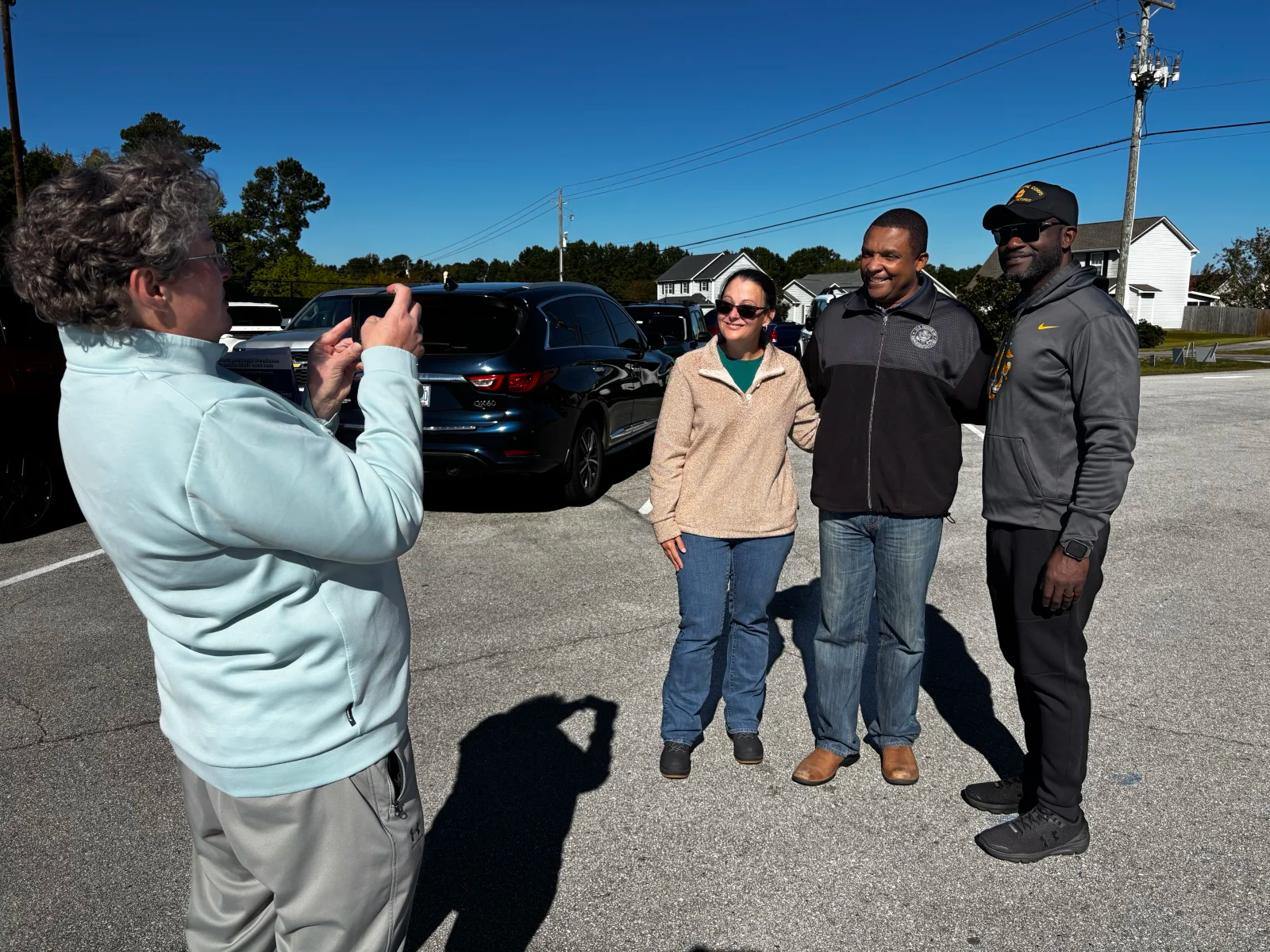
Congressman Don Davis poses for a photo with the district’s newly added Onslow County Board of Commissioners candidates before early voting ended. Source: NPR.
Rep. Don Davis (D-NC1) chases voters fearing racial disenfranchisement and Republicans in a bid to overcome the redistricting threat to his re-election. He faces an uphill battle to keep his seat after the North Carolina State Legislature redrew the historically black NC-1 district to be more Republican-leaning last year. This new mapped led to a drop in the Black voting-age population from 41% to 32%. Davis may find it harder to keep Black political representation alive in the state’s redistricted historic Black Belt region now that African-American voting power could be weakened.
Unlike disproportionately impacted Black voters, Davis’ opponent Laurie Buckhout may benefit from the GOP-friendly map after losing by only 6000 votes two years ago. The redrawn map followed President Trump’s call for the GOP to gerrymander as many seats as to protect their House majority, pushing to change the maps sooner than scheduled after next decade’s census. The Supreme Court weakened the Voting Rights Act in June, strengthening the Republican firewall and targeting many Black Democrat incumbents for defeat, like Rep. Davis. However, he finds increased support from early Black voters angered by the SCOTUS Louisiana v. Callais (2026) decision, which protected minority groups’ political power and fair political representation.
Both candidates seem to share many similarities in one of the most expensive and competitive races nationally. Davis touts his centrist voting record supporting Republicans in defense and immigration policy to reach across the aisle to new red communities, such as Dare County. Likewise, Buckhout leans into her partisan advantage in the district, though silent on redistricting. After seemingly decisive gerrymandering, both sides of the election have become more identical and expensive.
Political analysts may hypothesize East North Carolina’s anti-polarization follows the Median Voter Theorem, where the winning side could be the one whose policy preferences align most closely with those of the Median Voter. Now his third campaign on a new map redrawn three times, centrist incumbent Rep. Davis could be resistant to the redistricting threat to Black voter turnout. He may hope split-ticket voting will follow other Southern purple states in popularity for his centrist success in gerrymandered East North Carolina. Both Davis and Buckhout seem to have the same prerogative: keep turnout high.