
The Problem with Offering American Cities as Sacrifices
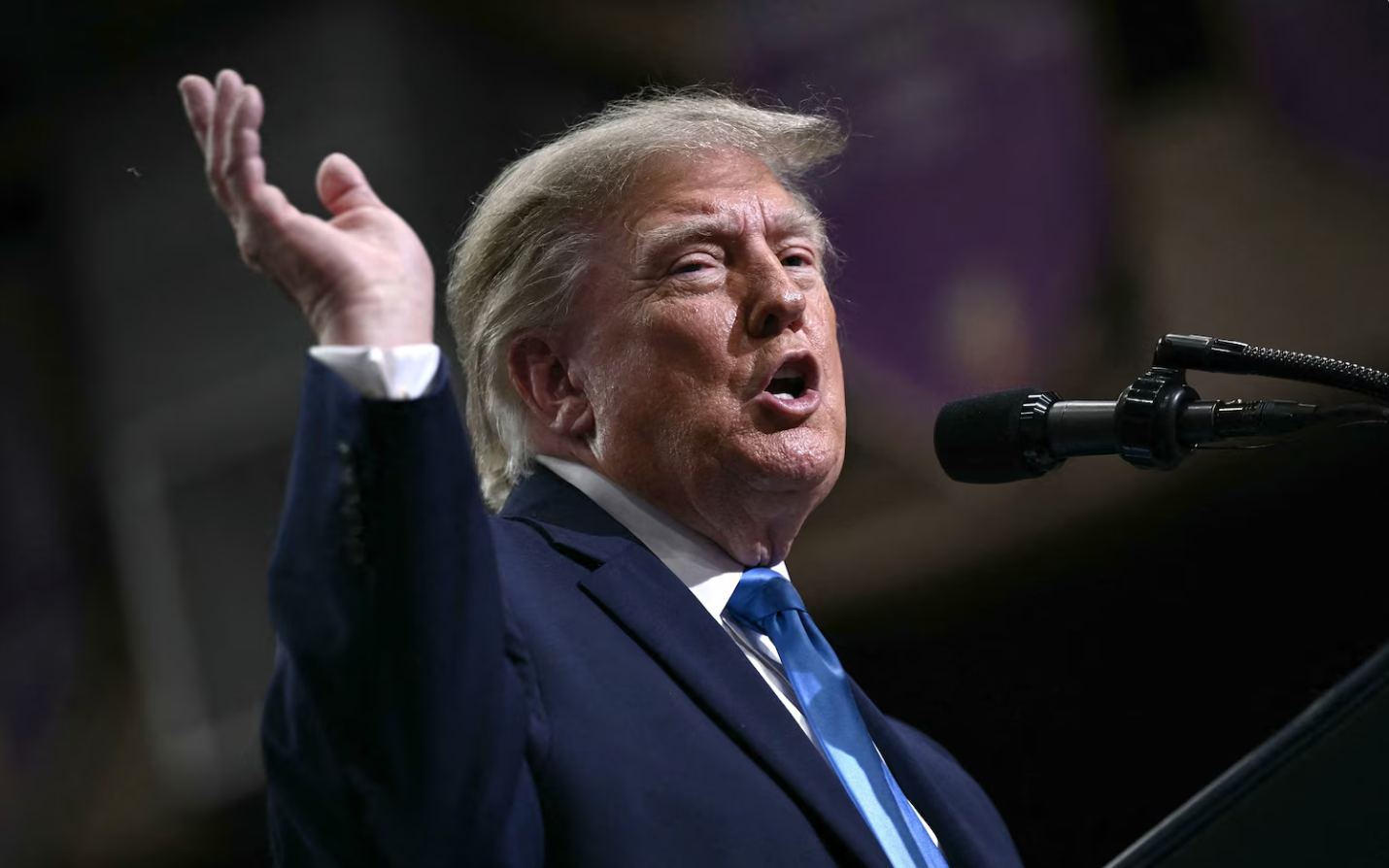
President Donald Trump speaking at a rally in Vandalia, Ohio. Source: ABC News.
At Donald Trump’s rally in Grand Island, Nebraska, the President said that the nation should “let [Iran]” unleash nuclear weapons upon the Californian cities of Los Angeles and San Diego. In preparation for the upcoming midterms, Trump could aim to invigorate Republican voting with a campaign consisting of rallies in 35 locations. His provocative remark in Nebraska is both a disgusting display of ignorance and a threat to American citizens. Inflammatory rhetoric should have no place in politics, especially on the campaign trail, as it emboldens extremist views and plays a divisive role within a nation.
Trump said that letting Iran take out Los Angeles and San Diego would be “a small price to pay” during a tangent about the nation’s safety and gas prices. By no means would the loss of Los Angeles and San Diego be a minuscule cost. These two counties have a combined population of over 13 million. Trump’s criticism of these cities does not take into consideration the millions of Americans that could be put at risk.
As of 2024, Los Angeles County ranks second among all U.S. counties in gross domestic product (GDP), and San Diego County’s economic output surpasses that of 20 U.S. states. Losing Los Angeles and San Diego could devastate the United States economy. Trump’s brash comments additionally neglect that San Diego is home to the largest military concentration in the world and the largest nuclear-powered warship—the USS Lincoln. This warship, along with its carrier strike group consisting of the USS Spruance and USS Pinckney, is deployed in the Middle East helping dismantle Iran’s nuclear facilities. Trump disrespects the Americans in uniform who are courageously fighting his war. The soldiers and sailors putting their lives on the line deserve a president who sees their cities as worth defending, not as a “small price” to pay.
An equally alarming element is the cheers in response to Trump’s statements. The language political leaders use holds immense power since many voters rely on elite cues—signals from political elites in government and media that citizens rely on as shortcuts to curate political views and opinions. Cheers erupting after the president offered to “let” Iran “take out” two American cities showcase that this kind of rhetoric is not only tolerated by his audience but rewarded. Trump’s followers received a cue that this view is acceptable within their group. Applause from an audience of loyal supporters then signals social approval to everyone watching the clip as well, which can further normalize rhetoric in an increasingly digital age that would once have been heavily reprimanded. By casting those living in Southern California as an out-group, Trump risks deepening affective polarization and targeting fellow citizens.
The Trump administration has since defended Trump’s original remarks after receiving backlash from California officials: Governor Gavin Newsom said the president was “deranged and dangerous,” and San Diego Mayor Todd Gloria said that Trump should “keep our city out of your reckless war talk.” The White House communications director, Steven Cheung, said, “He was clearly stating U.S. cities would have been threatened if a nuclear Iran hadn’t been stopped.” Instead of retracting or clarifying the remarks, the White House offered a half-baked reinterpretation. Cheung rephrased Trump’s original statement by claiming that a crisis has been averted. The permissive phrasing, “let them take out Los Angeles, let them take out San Diego,” is not a description of a past hypothetical—it is a threat to American cities.
There needs to be a standard of communication to which elected officials are held. Those at the head of the government must treat the livelihoods of all citizens equally, regardless of their partisan affiliation. Careless phrasing and instigative rhetoric from the highest office in the country can signal to adversaries that American lives are negotiable. The White House had the chance to retract the remarks and reassure Californians that their safety is not a bargaining chip, yet it chose to deflect. Leaders should be judged by a certain level of respectable political discourse just as much as their policies. Until that standard is enforced, the cost of casual cruelty could keep falling on those it targets.