
To Bail or Not to Bail: RAF Fairford Divides Atlantic Allies
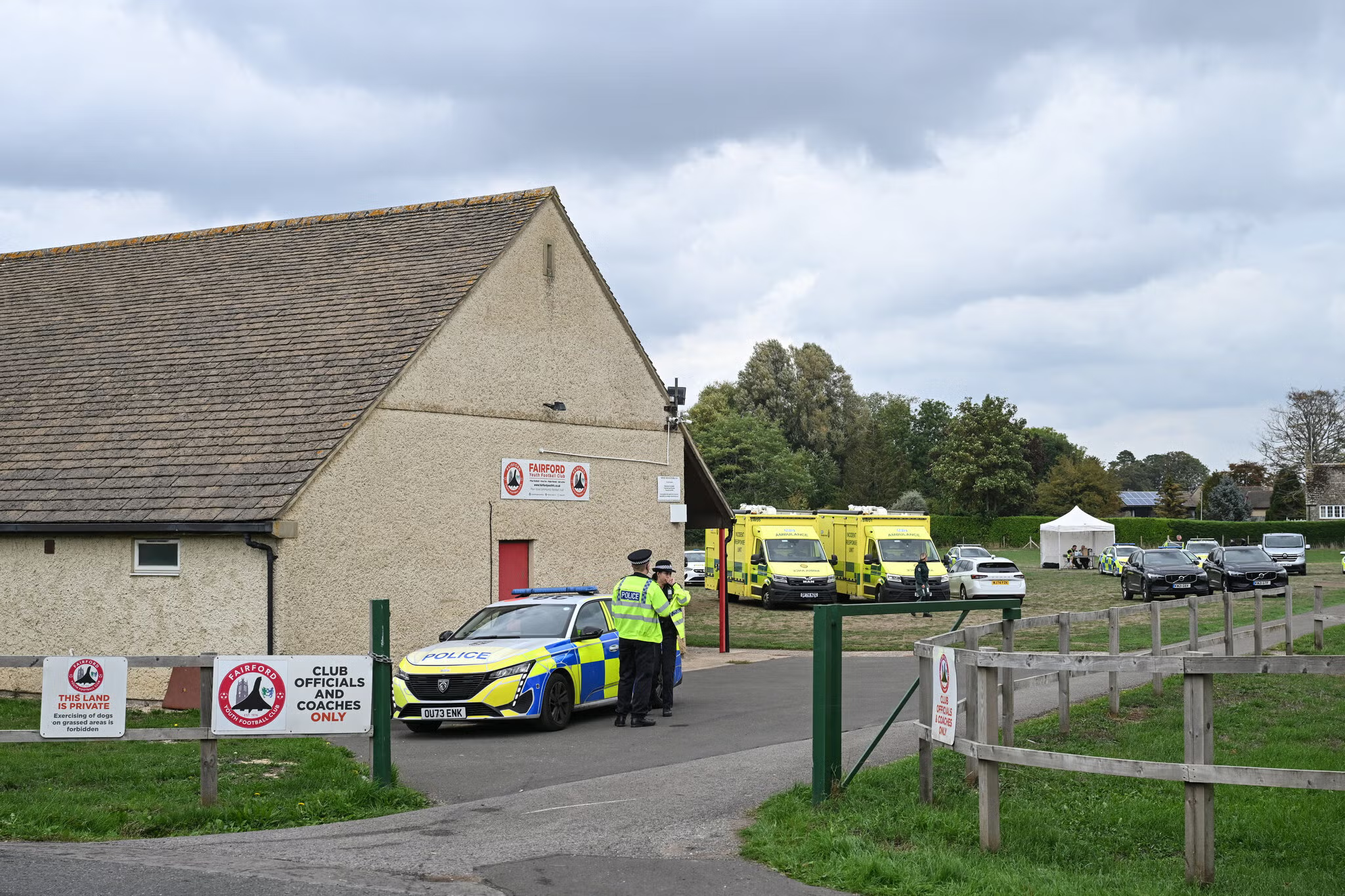
UK Police stand outside Fairford Youth Football Club near the RAF Fairford base in Gloucestershire, England on September 27, 2026. Source: New York Times.
The small English village of Whelford is reeling from a potential terror threat thwarted at Royal Air Force Fairford, an incident that drew conflicting international scrutiny. U.S. Secretary of State Marco Rubio, Iranian Foreign Minister Abbas Araghchi, and UK Prime Minister Andy Burnham contradicted each other in this international security threat. RAF Fairford is an air force station in Gloucestershire, UK and serves as the U.S. Air Force’s only European airfield for heavy bombers, but American B-1 bombers have since withdrawn from the base. Officials could now be left questioning whether the sleepy village was targeted for Iranian drone attacks or if the bailed suspects pose no genuine danger.
Analysts continue to pick apart the contradicting British and American security responses to what could have been one of the sharpest diplomatic rifts in modern transatlantic history; locals are left to wonder what the foiled bomb threat could mean for their security and whether Whitehall and Washington will remain aligned in countering collective intelligence and security threats on British soil.
Reports that a local farmer called in a suspicious group of masked men travelling toward the airbase in white vans dominated headlines early in the morning on September 27. Although initial British coverage suggested that national security hung on a single farmer’s alert, it soon emerged the first call was actually made by one of the five suspects. The police later confirmed that the vans contained containers of petrol rather than assembled explosives.
The miscommunication extended beyond the public to government officials. Secretary of State Rubio told Fox News soon after the incident that a “foreign actor” was involved, while Reform UK leader and Member of Parliament Nigel Farage immediately called for the suspects’ identities to be released, alleging that Iranian agents had come to the UK via “small boat crossings.” UK Culture Secretary and Member of Parliament Lisa Nandy derided Farage's attempts as irresponsible conspiracy-mongering. Many drew similarities to his Islamophobic and falsified social media posts that led to far-right protests following the 2024 Southport stabbings. Critics may lay blame on officials' miscommunication and silence as the cause for far-right conspiracy propagation.
Meanwhile, the British Counter Terrorism Police were quick to clarify that the five men were all, in fact, British nationals in their twenties from London. These cross-continental discrepancies have left analysts questioning the degree of intelligence alignment between London and Washington, and whether there could be something larger looming beneath the surface they cannot agree upon, either beyond their borders or their own political self-interests.
Inconsistencies between the allies’ official responses and accounts to the security threat may seem to cause more rifts and confusion in their alliance than initially thought. While the U.S. President Donald Trump claimed that authorities were aware of the suspects before the threat was called, UK officials explicitly said the operation was not intelligence-led, but was a real-time emergency reaction. This public digression is rare for the allied bilateral relationship, suggesting that there may be more debate on what the exact facts are in this incident. Trump continued to publicly deviate from British officials’ accounts and criticized how the five suspects were released on bail within 36 hours of the incident, though Whelford residents still cordoned off from their homes.
Two additional suspects, including one British-Iranian national, have since been arrested and similarly bailed since the incident. Security experts remain divided on whether Trump was right to criticize the investigations British police are conducting or whether there is more complexity to the case that American officials are too hasty to generalize and act upon, especially considering the airbase is still property of the British Ministry of Defense. The divided decision to grant bail may also allude to British intelligence withholding information and trust from American intelligence, or if there is a larger threat the latter did not consider.
Strategic divergence became more visible when 10 Downing Street insisted RAF Fairford was secure, even as Trump suggested a newer drone attack threat prompted the withdrawal of American B-1 bombers. This operational disconnect suggests that Washington acted unilaterally without coordinating with British commanders. In July, the British government dismissed Iranian threats of labelling UK bases used by the U.S. as ‘legitimate targets’ and Trump’s criticism of not being more involved in the Strait of Hormuz. However, if this drone attack threat is as severe as Trump implies, critics may raise questions over whether the U.S. would unconditionally stand by its partners, and if British defense and intelligence would be ready to counter this threat independently.
If the bomber withdrawal signals a broader retrenchment of decades-long American military commitments to the British military, experts may call into question vulnerabilities in British readiness for conflict against adversaries. Earlier this year, the UK Air Chief Marshal Sir Richard Knighton warned that the UK armed forces were not as ready as they needed to be for the full-scale conflict they might face, citing a £28 billion shortfall in defense spending. British policy analysts may see the defense spending debate as one of the first dominoes to destabilize former Prime Minister Sir Keir Starmer’s government, culminating in John Healey resigning after the administration capped only 2.6 percent of the nation’s GDP for defense instead of 3 percent.
This fiscal ceiling renders the UK the third-lowest-ranking NATO ally in increasing defense spending since 2014, resulting in the smallest British Army since the Napoleonic era. As defense think tanks urge London that the military needs to focus on domestic defense, not overseas missions, critics may be valid in thinking that the UK wouldn’t be sufficiently ready to defend against a real bomb threat at RAF Fairford or another military base.
The friction surprises both analysts and locals, who may still be puzzled at the departure from the close and long diplomatic relationship that the two nations enjoy in the South West. Though RAF Fairford has recently been used as a forward operating base for the U.S. to target Iran’s missile capabilities, it has historically played a prominent role during the Cold War, Gulf War, and Iraq War, with a rich history in helping Allied Forces in World War II during the Normandy Landings. The local village of Whelford is home to Americans deployed to the airbase, with many often integrating into local parish life, participating in events such as the annual Royal International Air Tattoo air show.
American defense cooperation is also prevalent in the county Gloucestershire, home to the NATO Allied Rapid Reaction Corps Headquarters, one of NATO’s few land rapid response forces headquarters in Europe. The county is also home to the nation’s intelligence and security centre, GCHQ (Government Communications Headquarters), the U.S. National Security Agency's British counterpart. The concentration of high-value strategic assets near Fairford means that any security breach could potentially carry catastrophic implications for transatlantic intelligence frameworks.
Since the campaign on Iran started, many Britons have protested the controversial decision former Prime Minister Keir Starmer made in allowing the U.S. to use RAF Fairford for defensive strikes in Iran. Now, local representatives may join the parade of dissenting voices against U.S. use of the base, questioning the lack of transparency given to the rural residents between Trump’s claims of long-term surveillance and the uncoordinated local security response that has fostered deep skepticism.
While locals are accustomed to geopolitics at their doorstep, the lack of transparent or united communication from both American and British officials may come as an eerie surprise. Now that American bombers have withdrawn, residents may question if British and American officials’ uncoordinated responses should be the new normal for their “Special Relationship” or if American officials are prioritising their national interests after using British resources and airbases for their war in Iran.
Once removed from the Iranian conflict due to “mission creep” fears, the UK now finds itself implementing larger sanctions after the incident, especially after Prime Minister Burnham decisively announced the events two weeks ago were “almost certainly directed by Iran’s Islamic Revolutionary Guards.” However, after a two-week delay on Burnham’s announcement, analysts have yet to find an exact explanation connecting Rubio and Trump’s earlier emphatic claims over their allies’ troubles.
Critics and supporters alike may be left to wonder if there was any connection at all or if their Iranian adversaries wanted to test and publicize the tension between the two transatlantic allies. Whether it’s simply American narrative dominance versus British security complacency, defense experts may find out too late if this rural village was the target of an Iranian feint or a sign of deeper fractures between the UK and the U.S. Regardless, as Whelford residents settle back into the rhythm of daily life, the episode leaves the “special relationship” facing unprecedented strain over transatlantic security coordination.