
Liberty, Égalité, Révolte: The Betrayal of A Cause
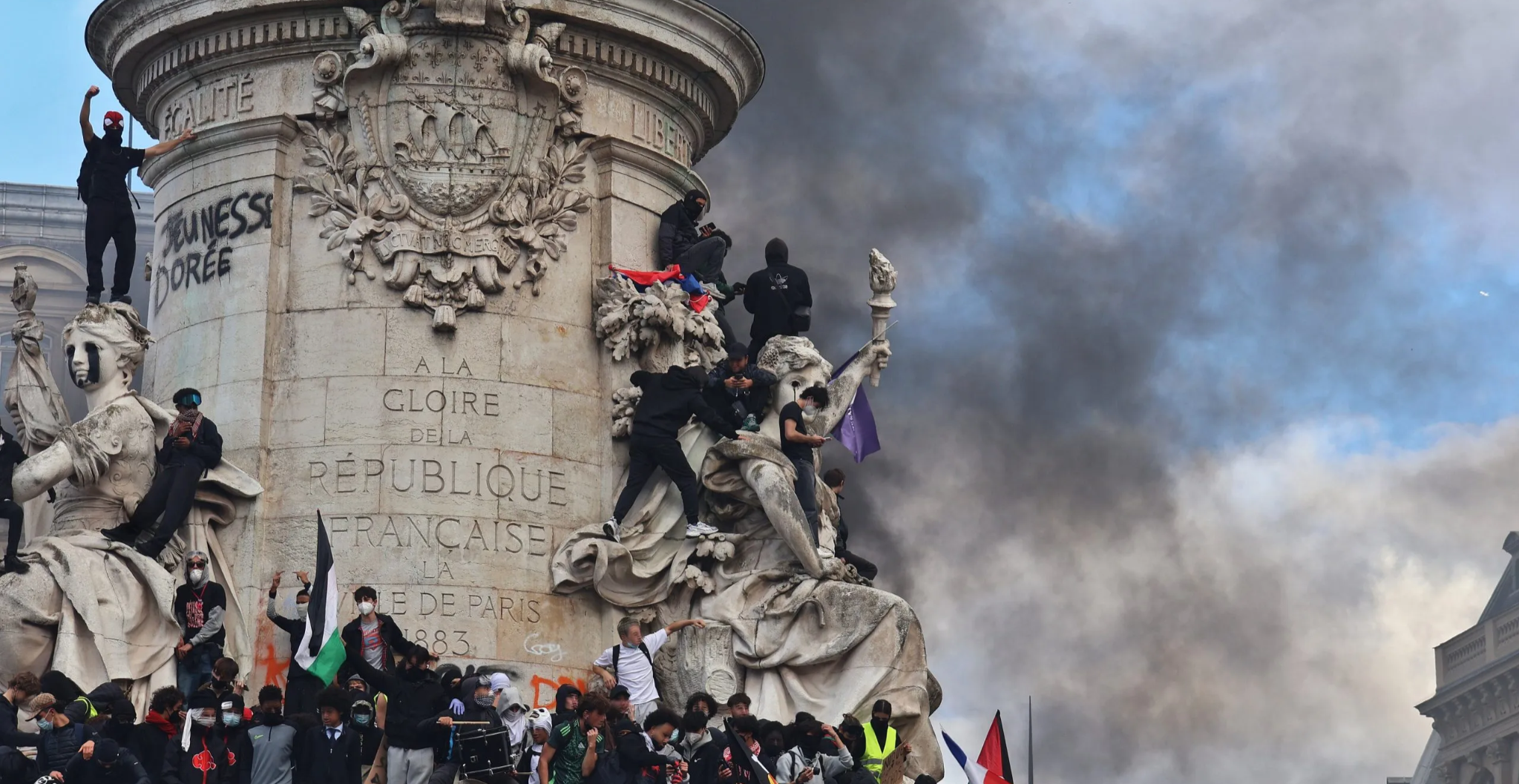
Demonstrators and high school students gathered on the monument to Marianne at the Place de la République in Paris, October 17, 2026. Source: Workers’ Liberty.
As violence has settled over France after intense protests, it is hard to believe that it all began with a dumpster. This autumn, high school students dragged trash bins in front of their lycées to dramatize crumbling classrooms, absent teachers, and budgets that didn't adequately fund education. Their demand, a 10 billion euro investment in the nation’s schools, was concrete, and to many outside observers, reasonable. Within weeks, trade unions, the revived Yellow Vest movement, and figures such as Greta Thunberg had joined them, and the cause widened with each recruit. Unions added a public-sector fight over a 54 billion euro austerity package, and Yellow Vest organizers called on social media for a revival of their 2018 revolt over living costs. An estimated 550,000 people, by the government’s count, and 800,000 by the organizers’, marched against the cost of living and the decay of public services.
That should have been the story. Instead, the story became the nineteenth-century city hall in Limoges, whose roof collapsed in flames, and the several hundred shop owners whose storefronts were smashed and emptied. Interior Minister Laurent Nuñez reported more than 1,800 arrests, more than 500 injured police officers, gendarmes, and firefighters, and “considerable property damage.” The right to protest is not a favor granted by the state. In France, it is a prerogative of its citizens. Article 11 of the 1789 Declaration of the Rights of Man and of the Citizen protects the free communication of thoughts and opinions, and the Constitutional Council has since recognized a right to the collective expression of ideas.
What then, should mass protest look like?
Demonstrations should look like most of Saturday’s crowd: loud, inconvenient, and unarmed. Legitimate protest pressures the powerful. It may block a road for an afternoon, fill a square, or close a school for a day, and the public will tolerate the disruption because it is temporary and aimed at those who hold power. The line for tolerance is crossed when the target becomes the average citizen or community. Against such victims, disruption has degraded pressure meant for the powerful. Article 4 of the 1789 Declaration, the same text that protects dissent, defines liberty as doing whatever does not harm others.
At that point, disruption has stopped being speech. It is devastation, and the person who pays is seldom the official being petitioned.
Defenders of the mass protests this weekend reply that the violence came from a small fringe—they have a point. Nuñez himself blamed “several thousand ultra-left individuals,” a fraction of the hundreds of thousands who marched peacefully. To condemn an entire movement for the actions of a violent minority would be unfair and discredit the legitimate grievances of the students and demonstrators. Yet, the fact that violence came from a minority does not diminish its consequences. In light of public buildings burning and businesses being looted, the movement’s original demands have become overshadowed by destruction. This allows opponents to shift the debate from educational reform to the restoration of public disorder. Peaceful protestors should not bear the responsibility for crimes they did not commit, but the movement’s organizers must unequivocally distinguish their cause from those who exploit it as an excuse for violence.
Many on the right, at home and abroad, see something larger, and that reading shows how thoroughly the students’ message was lost. Marie Le Pen said France is “paying for decades of anarchic immigration,” while Donald Trump said that France had been “conquered, looted, and burned to the ground by migrants, jihadists, and communists.” Within days, a quarrel over substitute teachers had become a proxy war over immigration and Islam, and the students’ demands were its first casualty. It’s understandable as to why far-right politicians equate burning public buildings and waving Palestinian flags in some crowds with that reading. Yet the data collected by authorities and law enforcement so far does not support the claim that migrants are to blame. Political scientist Pascal Perrineau argues French citizens of immigrant background were only one subgroup in crowds that also held students and black bloc radicals.
Beyond the political aspect lies a far more challenging reality for the state. The core issue is not the identity of the marchers, but the deep-seated structural neglect that breeds such volatility in the first place.
Decades of housing policy and market forces concentrated poorer households, many of immigrant origin, in estates where two-thirds of the priority neighborhoods lack a public employment office. Where the state is absent for years and appears mainly as riot police, a violent minority can borrow any cause, including the students’. Authority comes from more than force: it comes from the teachers, caseworkers, and officers who are present daily and trusted because they are fair. Rebuilding that trust in France’s poorer neighborhoods means staffing the schools and employment officers, prosecuting arsonists swiftly, and expelling convicted foreign nationals where French law allows. The specifics, however, remain in the hands of the courts.
Responsibility has a practical form in this scenario. The shopkeeper with an empty storefront and the Limoges taxpayer never marched for or against anything. Many citizens caught in the destruction of the protests are small-business owners facing financial ruin; workers whose livelihoods were destroyed overnight; and residents left to pick up the pieces of their neighborhood. Economy Minister Roland Lescure said the damage was worth “tens or perhaps hundreds of millions” of euros. The state has promised a reconstruction for public buildings without naming a sum, and a riot-insurance guarantee made mandatory this year may not apply, because its implementing decrees remain unpublished. The mayors of Paris, Marseille, and Lyon asked the prime minister for an urgent meeting given the extent of the damage.
The state is not blameless. Human Rights Watch reports that a fifteen-year-old lost a hand to a police stun grenade and a fourteen-year-old similarly suffered a shattered jaw from a tear gas canister. A republic that answers a teenager's blockade with injuries like that forfeits some authority to demand lawful conduct, and protecting peaceful marchers is what makes prosecution of violent ones credible.
President Macron’s response has satisfied almost no one. Relying heavily on security measures, the president blamed “seditious” ultra-left groups trying to “bring down the Republic” and promised to ban “illegitimate” protests, with places like Lille, Paris, Lyon, and Grenoble barring marches. Justice Minister Gérald Darmanin confirmed that 217 people have been convicted and jailed.
Order must be restored, but banning marches after failing to prevent the arson invites the charge that the peaceful majority is being punished for the government’s lapse. Unions say their talks with Prime Minister Sébastien Lecornu produced no concrete proposals. Voters appear unpersuaded: Macron’s approval rating stands at 15 percent, the lowest of his presidency, while Le Pen leads polling for the 2027 French presidential election at 32 percent; the left-wing firebrand Jean-Luc Mélenchon, who backed the students, holds the support of 49 percent of voters aged eighteen to twenty-four.
Mass protest earns its legitimacy from numbers, discipline, and its message. The marchers of October 17 had the first and deserved the third. Those who burned and looted stripped them of that legitimacy, while the government responded with crackdowns rather than solutions. If the movement wishes to be remembered for its demands—a meaningful 10 billion euro investment in classrooms, teachers, and the future of French education—it must be as insistent on separating itself from the arsonists of the movement as it is on confronting the government.