
Will Economic Frustrations Turn North Carolina Blue in 2026?
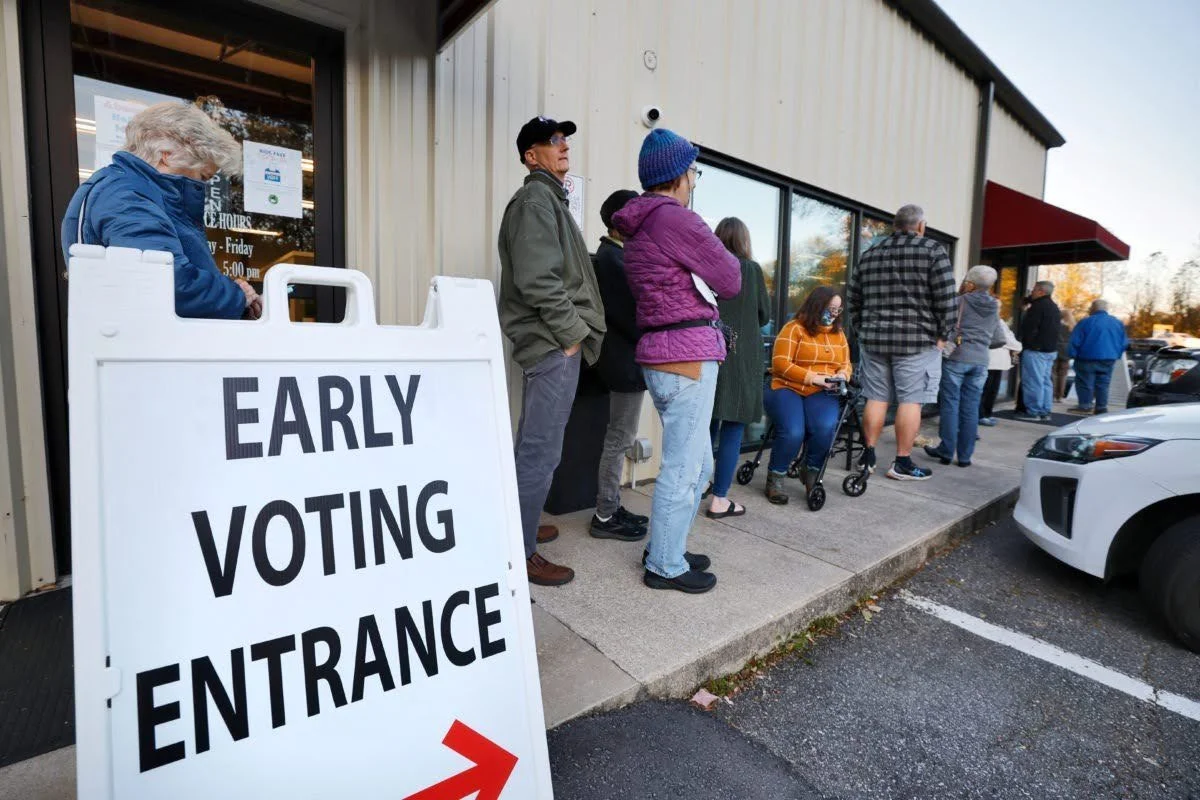
Voters line up to cast their ballots on October 17, 2024, the first day of early in-person voting in Marion, North Carolina. Source: PBS News.
Early voting in North Carolina is fully underway. With less than one day until election day, many are looking to North Carolina to see what comes out of this purple swing state. Last year, North Carolina had one of the highest municipal turnouts in recent history, with more than 19 percent of registered voters casting ballots for local candidates. Even now, just days into the early voting period, the number of votes cast is up 48 percent compared to 2022 midterm totals at the same point in time.
For many voters, affordability is the top issue. As of September, a Catawba College/YouGov survey found that 78 percent of respondents in NC found the issues of affordability, jobs, and rising prices to be “very important.” These concerns line up with the current economic climate. According to the Bureau of Labor Statistics, the Consumer Price Index in the South region increased by 3.4 percent over the whole year, while energy prices have increased by 3.6 percent in just September. The U.S.- Israeli war with Iran and the closure of the Strait of Hormuz have contributed to the increased gas prices nationally. Current national average gas prices as of October 19, 2026, are $4.30 and diesel at $6.32. For everyday North Carolinians already struggling with the rising cost of living, these increases can make it harder to afford basic needs and essential expenses.
In response to rising energy expenses, the NC General Assembly recently passed a gas tax suspension until November 30. While the suspension has received bipartisan support, there have been allegations from Democrats that the tax was only implemented by Republicans to cynically win votes on election day. Despite the lowered prices, one gas station customer said, “They're still high. Still a lot of money out of my paycheck."
The current state of the economy is drastically different from what President Donald Trump promised during his 2024 presidential campaign. In a speech to the Economic Club of New York in September 2024, Trump said he would lower “gasoline below $2 a gallon” and “bring down the price of everything from electricity rates to groceries, airfares, and housing costs.” On election night, after securing his victory, Trump said, “I’m not going to start a war. I’m going to stop wars.”
This gap between campaign promises and the economic reality facing many North Carolinians raises the question of whether voters will hold the Republican Party and its candidates accountable for these failed commitments during midterms. Many NC Republicans are moving away from identifying with and supporting the president. A Catawba College and YouGov poll conducted in early October 2026 found 61 percent of NC Republicans now call themselves party Republicans rather than Trump Republicans. Additionally, the presidential job approval rating is at a historic low of 36 percent. While these results do not mean that Republicans will vote against their party in midterms, they may highlight a challenge for Republican candidates in future elections: either to continue aligning with the president or maintain support from party voters frustrated with the Trump administration. Meanwhile, Democratic candidates may also feel pressure to demonstrate that their policies offer credible solutions to constituents’ economic concerns.
This tension is particularly visible in North Carolina’s U.S. Senate race between former Democratic Governor Roy Cooper and Republican Michael Whatley, the former chairman of the Republican National Committee. Cooper has centered his campaign on affordability, focusing on “making stuff cost less,” while Whatley, a strong Trump ally and loyalist, has emphasized crime. Republicans have frequently made crime a top issue in their election campaigns; however, this year it does not seem as potent a campaign point as in the past. One possible reason is the significant decline in violent crime. According to the Crime Index, reported violent crime decreased by 21.2 percent from January to August 2024 and January to August 2026.
As fewer North Carolina Republicans identify primarily with Trump, Whatley’s close alignment with the President and limited focus on affordability may explain his lower polling numbers compared to Cooper. A recent poll conducted from October 7 to 11, 2026, by WRAL-TV/SurveyUSA found Cooper leading Whatley by 14 points. As a result of this double-digit lead, Republican-aligned super PACs are moving away from spending in North Carolina and focusing on more critical states like Texas and Kansas. For instance, Old North Action removed $6.5 million in ad funding from the North Carolina Senate race. However, while the Democrats and Cooper’s comfortable lead, it is far from guaranteed. Unaffiliated and undecided voters who often vote later typically lean Republican and could ultimately shift the election results.
North Carolina has voted across party lines. In 2024, North Carolina voters elected five Republicans and five Democrats to the Council of State, the ten-member body of statewide elected officials who lead the state’s executive branch. The 2026 midterm elections will test whether concerns about affordability, discontent with the Trump Administration record, and low presidential approval translate into a decisive shift towards Democratic candidates in key races down the ballot. However, the outcome is uncertain as voting continues.
Voting locations are open from 8 a.m. to 7:30 p.m. Monday through Friday, 8 a.m. to 3 p.m. on Saturdays, and 12 p.m. to 5 p.m. on Sundays.
Voting on the same day is still an option at any early voting site in Orange County. You must provide proof of residency in Orange County. Early voting sites can be found here.