
4 Key Takeaways from the 2026 Midterm Elections
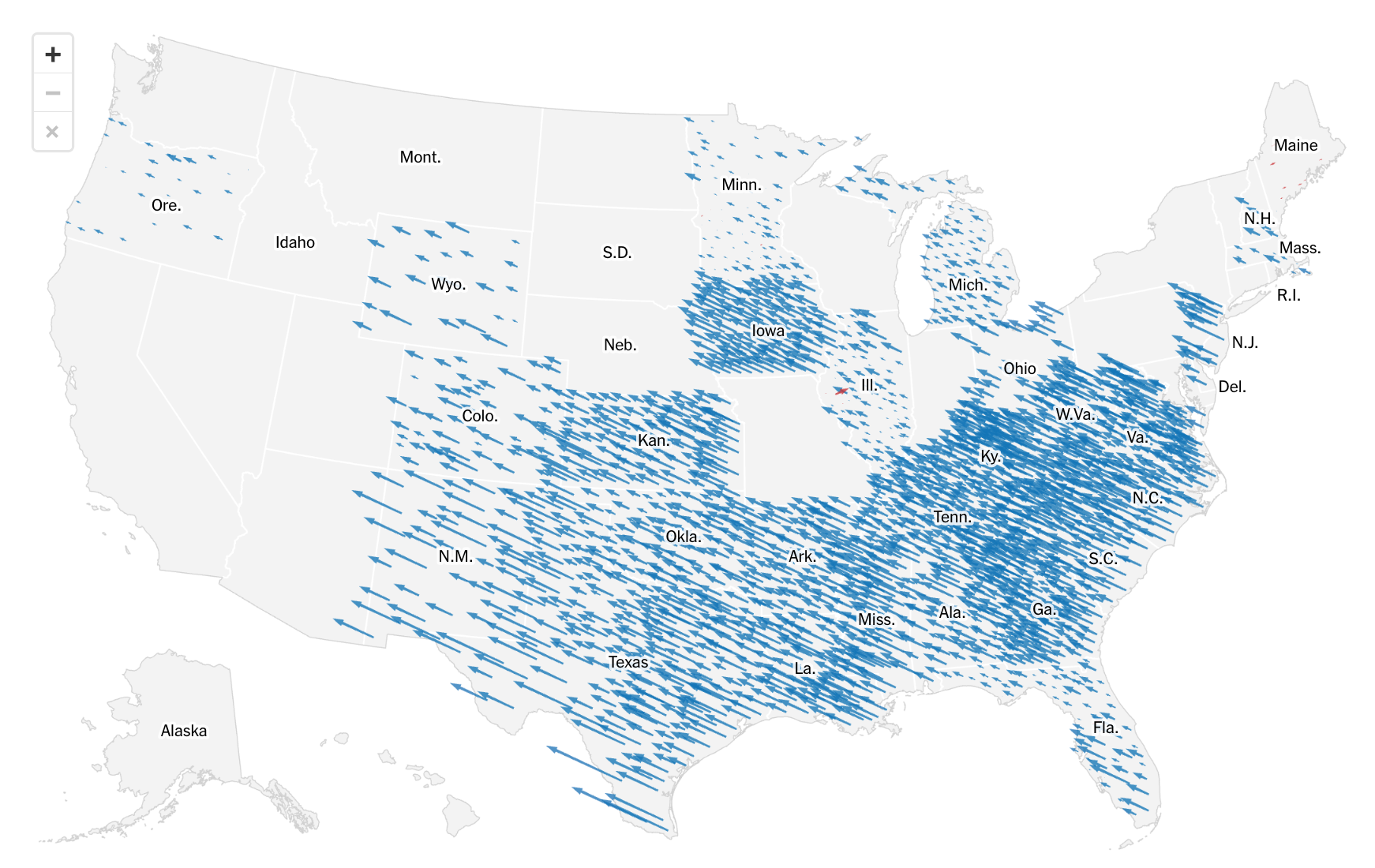
Shift in each county in the 2026 U.S. Senate races compared to the 2024 presidential election as of November 4, 2026. Source: New York Times.
The results of the 2026 midterm elections can be described as nothing short of a Democratic mega tsunami—a torrent even. While several key races remain uncalled, Democrats appear on track to win about 260 seats in the U.S. House of Representatives and a staggering 55—perhaps 56—seats in the U.S. Senate. Most Democrats would not have believed you if you told them these were the results on November 2.
The scope of this win has shattered the illusion of the invincibility of the MAGA coalition, with the President’s political position seeming to be at its weakest since he rode down his golden escalator more than 11 years ago.
Perhaps most devastating is the uniformity of Republican underperformance across the country. From the Deep South to the Rio Grande Valley to the Great Plains to New England to the industrial heartland, in communities big and small, urban and rural, college-educated and not, the floor has fallen out for the Republican Party. They appear to be losing majorities in a dozen state legislative chambers, while losing supermajorities in many others, 6 governors’ mansions, as many as 9 Senate seats, and about 45 House seats. As of November 4, 2026, Democrats have improved upon their 2024 performance in almost every single federal election held last night.
There are as many takeaways from last night as there were elections, but several key developments stand out: how the results will change the way we see the polls, how Republican gerrymandering backfired, how the MAGA coalition fractured across every demographic it had built, and how Gen Z has emerged as the nation’s quintessential swing vote. Understanding them offers a window into what is to come as seemingly the final act of the Trump era begins.
The Presumption of Polling Bias Towards Democrats is Over
For almost the entirety of the run-up to Tuesday’s elections, Democrats were biting their nails down to the quick, agonizing that the polls, which for months had shown dominant Democratic leads, were leading them astray. The shadow of Trump’s shock 2016 win over Hillary Clinton, his surprising competitiveness in the 2020 election against Biden—who led Trump by an average of 8 points in the preceding polls—and Trump’s sweep of the swing states in 2024 left Democrats weary of taking polls at face value. Left-leaning political commentary has long been shaped by a reflexive distrust of Democratic poll leads and an almost guaranteed panic whenever polls showed even a slight Republican edge.
The polls leading up to the 2026 election were especially anxiety-inducing for Democrats and pollsters alike as Democrats seemed to be trouncing their Republican opponents in every Senate race, in states as traditionally uncompetitive as Alaska, South Carolina, Texas, and Kansas which had not voted for Democrats since 2008, 1998, 1988, and 1932 respectively.
Pollsters, wary of damaging their reputations yet again, even weighted down their polls, intentionally adjusting their empirical data with their intuitive read of where Democrats were “supposed” to be competitive. For example, the New York Times/Siena poll, published on November 1, showed raw data that put Democrat Josh Turek 4 percentage points ahead of Republican Ashley Hinson in the Iowa Senate race and Democrat James Talarico 9 percentage points ahead of Republican Ken Paxton in the Texas Senate race. To “correct” for allegedly higher Democratic response rates in these polls, the Iowa poll was adjusted down to Turek +1 percentage point and Texas to Talarico +7 percentage points. Unfortunately for the Times, they should have stuck with the unadjusted numbers as both candidates blew past their expected margin in the final polls.
Across the country, Democrats, almost instinctively expecting to underperform the polls, were met with a near-uniform Democratic overperformance, even compared to the most optimistic polls, winning handily in South Carolina, Kansas, and Texas. The polls in the governor’s races were particularly inaccurate. Democrats Gina Hinojosa of Texas and Cindy Holscher of Kansas blew past their polling deficits to, in Hinojosa’s case, decisively beat their opponents.
While this is not an invitation for Democrats to pull a complete 180 and trust that they will meet or outperform every poll in the future, it is cause for Democrats to stop assuming they will inevitably be let down by the real results on election night.
Election polls are properly seen as a snapshot of how voters approximately feel at a certain moment in time—nothing more and nothing less. As last night proved, the polls’ deviation from the final results can bias either party in a race. If Democrats focus more on using the polls as tools to show where they are competitive, rather than an indicator of whether or not they are actually going to win the race, they could save themselves a great deal of grief and time in the future.
The Dummymander Was Real
Infamously, Republicans attempted to manipulate the results of the 2026 House elections, otherwise known as cheating, by changing the boundaries that their candidates compete under, making swing districts safer and Democratic-held districts lean Republican. However, while political commentators focused on the dilution of Democratic districts with Republican votes, most missed that, to do this, Republican state legislatures had to dilute their state’s Republican-leaning districts with the Democratic-leaning areas of the districts they were dismantling. The consequence of this was that, if Democrats significantly outperformed their 2024 margins, the election that many of the gerrymanders were based on, Republicans could lose seats that they otherwise would have held. That is exactly what happened.
North Carolina is one of the best examples. Since the NC Supreme Court permitted partisan gerrymandering in a May 2023 decision, Republicans in the NC General Assembly have made a concerted effort to pack Democrats into as few districts as possible. By 2024, they had already turned a 7-7 House delegation into a 10-4 Republican gerrymander. However, this wasn’t enough for the NCGOP; they insisted on more. Eyeing Congressman Don Davis’ seat in North Carolina’s 1st, Republicans contorted the state’s map so that, even if Davis significantly outperformed Kamala Harris’ 2024 margins in the district, he would almost certainly lose to Republican challenger Laurie Buckhout.
However, like Icarus, NC Republicans flew too close to the sun. They underestimated former Governor and now Senator-elect Roy Cooper’s coattails, and Democrats performed historically well. Republican districts were diluted just enough that it now seems the NCGOP unintentionally drew themselves out of several seats. Among the apparent electoral casualties are some of NC’s most iconic delegation members, including House Rules Chairwoman Virginia Foxx, National Republican Congressional Committee Chair Richard Hudson, and former Speaker of the NC House Tim Moore. Based on the current results, it seems that North Carolina, instead of sending 11 Republicans and 3 Democrats, could send 11 Democrats and 3 Republicans to the 120th Congress. What’s that song by Alanis Morissette called?
Similar situations have played out in the similarly gerrymandered states of Texas, Florida, Tennessee, and Alabama, where Republicans either made no gains or lost seats. Will this end partisan gerrymandering as a political strategy? I doubt it. But this cautionary tale could lessen the extremes either party will attempt to use gerrymandering to distort the will of the people of each state.
The MAGA Coalition Came Apart at the Seams
“The MAGA coalition” shattered many of the conventions of American politics—some centuries old. Under Trump’s leadership, MAGA finally broke Democrats’ long-slipping hold on the white working class, slowly won over millions of Hispanic voters, particularly in South Florida and the Rio Grande Valley, and also made inroads among black voters, particularly young black men, for the first time since that demographic became solidly Democratic during the New Deal era.
This realignment cost Republicans various voters too. College-educated suburbanites, once the backbone of the Republican Party, began fleeing the party to support Democrats at the genesis of the Trump era. Even former leading Republicans such as the Bush and Cheney families have either refused to endorse Trump throughout his runs for office or, in the case of former President George H.W. Bush in 2016 and Dick and Liz Cheney in 2024, even voted for the Democrats in the race.
Unfortunately for President Trump last night, the elements of their old and new coalitions abandoned him and his enablers down the ballot. In New England, the last flicker of moderate Republicanism was extinguished with Maine Senator Susan Collins, who has defied political gravity for 3 decades, by winning the state as a Republican while the state has simultaneously backed Democrats for 34 years, lost to a fifth-generation logger who wasn’t even supposed to be on the ballot.
In Ohio and Iowa, blue-collar workers who flocked to the GOP in 2016 after backing Obama twice returned to their blue roots, sending Sherrod Brown and Josh Turek to the U.S. Senate, defeating two traditional, non-MAGA Republicans in the process. The gains Brown and Turek made were particularly concentrated in places like Mahoning County, Ohio, home to Youngstown, and Scott County, Iowa, home to Davenport. Both places are de-industrial, union-heritage communities that were once reliably Democratic. Last night, both swung about 15 points towards Democrats, compared to just two years ago, flipping both counties.
In Kansas, Texas, and North Carolina, Republicans lost what remained of their support among well-educated suburbanites. For decades, large metropolitan suburbs were the backbone of Republican strength and money in each state. Places like Cabarrus County in North Carolina, outside Charlotte, Collin County in Texas, north of Dallas, and Johnson County, based in Overland Park, south of Kansas City, have historically delivered huge numbers of Republican votes. While Republicans have been hemorrhaging votes in places like this throughout the Trump era, they consistently maintained healthy margins that counteracted Democratic gains in the cities that these suburbs orbited. However, Democrats Roy Cooper, James Talarico, and Adam Hamilton trounced their Republican opponents in these counties, with each winning historically ruby-red counties by double digits, and Hamilton carrying Johnson County by 28 points.
President Trump’s inroads with black voters in 2024 were of particular concern to Democrats. The loss of black voters, whom Democrats have taken for granted for far too long, threatened their hopes of competing in Sunbelt states like North Carolina and Georgia, and seriously endangered their ability to maintain comfortable majorities in traditionally true blue states like New York, New Jersey, and Illinois.
However, the Supreme Court’s decision in Louisiana v. Callais, which struck down §2 of the landmark 1965 Voting Rights Act and threatened black representation in Congress, appears to have driven black turnout to historically unprecedented levels for a midterm, and those voters returned to the Democratic column in remarkable numbers.
With this supercharged turnout, Democrats stunningly flipped the Georgia governorship in a rout and elected the first liberal in arguably all of South Carolina’s history. As of now, they also appear more likely than not to have won in Mississippi, where Scott Colom, currently the favorite, would become not only the first black Democrat elected statewide, but the first non-segregationist Democrat ever elected in the state. Even in races that Democrats ultimately did not win, the margins—often in single digits—in statewide races in places like Alabama, Tennessee, Florida, Arkansas, Kentucky, and especially the Louisiana Senate race, are nightmare fuel for Republicans.
Most dramatically, but perhaps least surprisingly, Republicans saw their support decline more among Hispanic voters than among any other racial group, particularly those living along the U.S.-Mexico border. Additionally, Starr County, Texas, continues to be one of the most interesting counties in the nation. It is over 97% Hispanic and voted for the Democratic presidential candidate for 136 consecutive years, giving 86.3% of its vote to President Obama in 2012. In 2024, Trump broke that streak, carrying the county by 16 points over Kamala Harris. James Talarico, however, won it by 49 points, restoring nearly all of the Democratic losses in Starr and the larger Rio Grande Valley region.
Hispanic voters, who swung an average of 28 points to the left relative to 2024, were by far the most likely to be targeted by, and affected by, the President’s draconian immigration practices, which detained American citizens and deported unauthorized but otherwise law-abiding immigrants to countries they had never lived in. The President failed to comprehensively resolve the very real crisis of illegal immigration at the southern border without resorting to practices that harmed American citizens and other devoted community members, and that failure cost Republican candidates dearly. Whether or not Hispanic reversion to the Democratic Party will cease once the Trump administration amends its immigration policies or if ICE’s reign of terror has left a permanent black mark on the reputation of the Republican Party with Hispanic voters remains an open question.
Gen Z is now the Quintessential Swing Vote
A final takeaway from the election is that Generation Z is the least politically committed voter demographic in the nation. In 2024, President Trump won 44% of the Gen Z vote, including a majority of Gen Z men, bucking the historical trend of younger voters strongly preferring Democrats. This was particularly notable, as it represented a 17-point swing to the right from how Gen Z voted in the 2020 election. However, just 2 years later, Gen Z has swung again—this time dramatically to the left. The New York Times exit polls suggest Gen Z broke for Democrats by a staggering 41 points—70% to 29%— a 32-point shift to the left.
What could this political volatility possibly reveal about Gen Z? Has Gen Z undergone such a rapid change of heart in just 2 years? The likely answer is no. Generation Z’s pendulum of political commitments is not indicative of any deeper ideological commitments or shifts. Rather, it suggests that Generation Z voters are motivated simply by anti-incumbent sentiment and channel their dissatisfaction with the society they are entering onto whomever is running it at that time, desperately hoping for change. The question of how logical this anti-incumbent sentiment is is complicated.
In some respects, Gen Z can, generally speaking, be too cynical. In many ways, this is because positivity is one of the greatest casualties of the digital age. In an economy where human attention is the most valuable currency, sensationalism, doomerism, and outrage-bait are the surest ways to keep people consuming whatever is being sold. Gen Z, the first generation to come of age entirely inside this ecosystem, has been immersed in unhealthy amounts of nihilistic content, which has fostered resentment and antisocial tendencies toward their society, their communities, and the people around them. A generation of knee-jerk cynics is unlikely to look for competence in any political party that is not delivering tangible results for them, thus making anti-incumbency the easiest political position.
However, there are also more concrete and material reasons why Gen Z has become so disaffected with both parties. Gen Z is burdened with immense student loan debt, faces less social mobility than any recent generation, is not expected to buy a first home until at least age 40, and faces comparatively few job prospects upon completion of education. Because many Gen Zers were disappointed by the Biden administration’s handling of affordability-related and macroeconomic issues, they were willing to give President Trump a second chance. However, now that Trump has failed to deliver anything more than a failed war with Iran, many Gen Zers have lost their patience with Republicans as quickly as they turned to them, opting to take their chances with Democrats again.
Nevertheless, Democrats could lose this returned Gen Z support by the next election if they don’t adopt a platform that actually seeks to ameliorate the greatest challenges facing young people today. Until one party’s leadership finds a way to properly deliver for Gen Z and ensure the American Dream is just as accessible to this generation and those that follow as it was for theirs, Gen Z seems likely to continue its on-and-off-again situationships with both parties.
Conclusion
The 2026 midterms were the most decisive and complete rebuke of either party since at least 1974, during the aftermath of Watergate. Republicans were routed up and down the ballot. Perhaps nothing better exemplifies this than Senator-elect Talarico pulling the sword from the stone and turning Texas blue—while also unseating every single statewide Republican in a regime change more complete than President Trump’s in Venezuela.
These results will reverberate through American politics for years—perhaps decades. The 2028 presidential race, which for all intents and purposes has already begun, has been shaken up. Anyone associated with the administration, particularly Vice President Vance and Secretary of State Rubio, now looks positioned substantially worse to become the Republican standard-bearer. This year, nearly everything the president touched, especially his candidates, died, and few will want to be labeled Trump’s heir after a defeat this cataclysmic.
Democrats, invigorated by the scope of their victory, will jump en masse into the 2028 race. The open White House seat and the inevitable chaos of the next two years set them up well to retake it. A figure like Georgia’s charismatic Senator Jon Ossoff, who posted once-unthinkable margins in his race last night, looks to be in a fantastic position to lead a presidential campaign. Still, only a very, very long primary can determine which Democrat will ultimately storm the castle.
A decade after he stunned the world with a shock victory over the establishment of both parties, the Trump era finally seems to be coming to a close, in an equally dramatic way.